
Physics (Bachelors Degree Programme, 3 years)
Physics
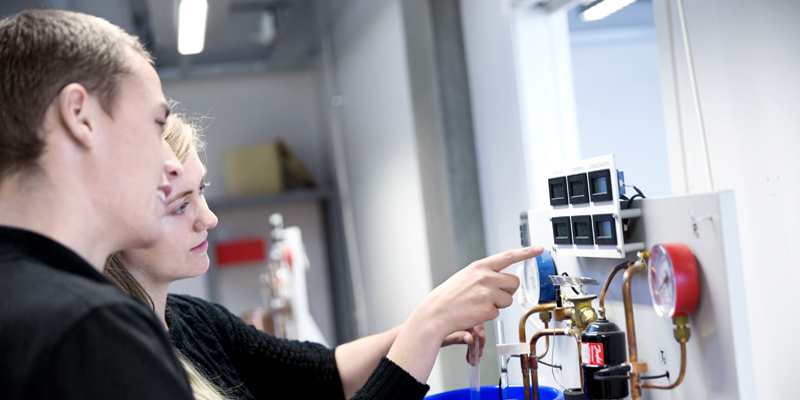
About physics
Nothing is too small and nothing is too big in the world of physics. Questions from the innermost to the outermost secrets of the universe are parts of this subject area. As are questions about how for instance the future climate and processes in the human body are governed by the laws of physics. The course covers many areas, from elementary particles to cosmology, and from biophysics at cell level to the development of oil technology, climate models to new understanding within the fields of material physics and nanotechnology.
In the Bachelor's programme you will first of all gain basic knowledge in mathematics and in the basis of physics: mechanics, electromagnetism, wave physics, thermal physics and last but not least; quantum physics, which play a central role in large parts of modern physics. Here you will acquire both theoretical and experimental techniques and skills. This study also provides you with a basis for further specialisation into the Master's degree programme. The Bachelor programme supplemented with a Master's degree will be a good starting point for a lot of jobs within the field of physics. For some, it may be of interest to go further, with research studies in the form of a PhD degree.
Admission
Language of instruction: Norwegian
You have to meet the Norwegian language requirements, or have a Scandinavian language as your mother tongue, if you want to apply to any of NTNU’s degree programmes taught in Norwegian.
The application deadline for the programme is April 15th. Students apply through Samordna Opptak.
- Study level: Bachelor
- Study programme: Physics - Bachelor's Programme
- Duration: Full-time
- Credits: 180
- Application code: 194857
- Ordinary quota: 2023 51.7
- Ordinary quota f. diploma: 2023 54
- Unit: Faculty of Natural Sciences
- Apply before: 15. april
- Location: Trondheim
Language of instruction
Norwegian