02 Idea evaluation
Idea evaluation
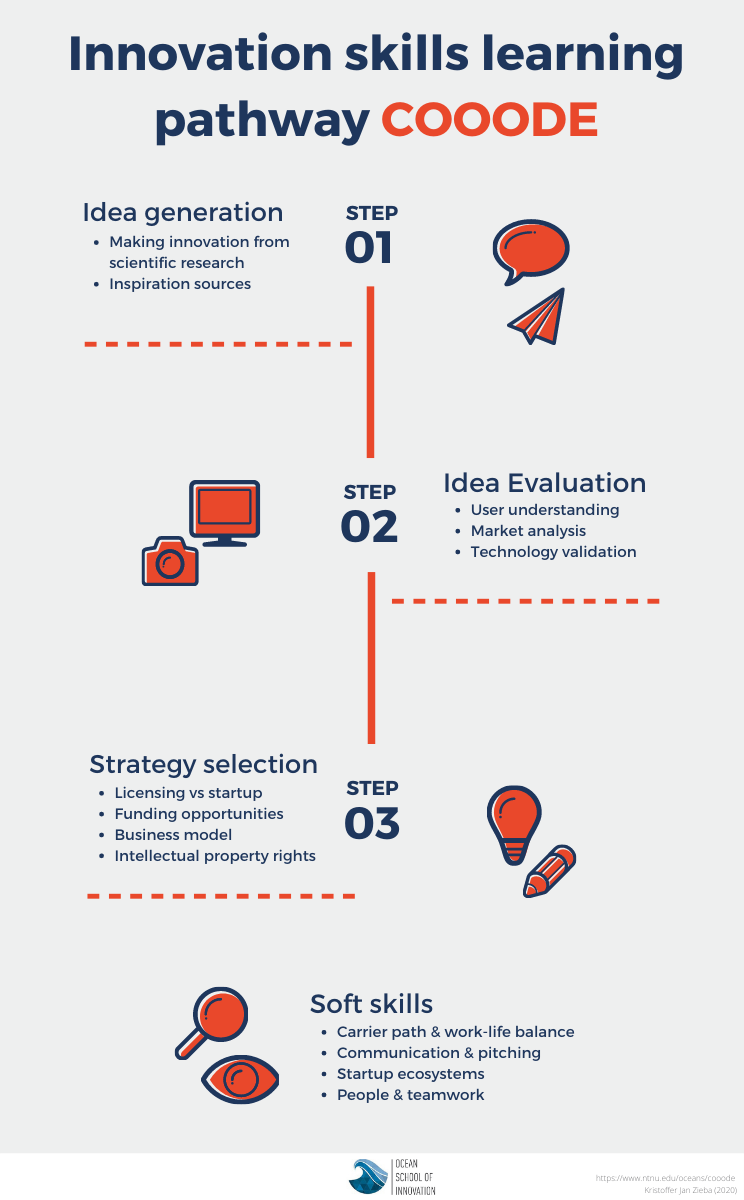
Research per definition leads to discovery and invention. It is the epitome for newness and change. Nevertheless, there is a big step to be taken from technological or scientific invention to innovation. A reason for this is that core of innovation lies not only it the newness itself but in introduction of the newness (be it technological, scientific, or organizational) to the market. The introduction can happen in different forms - through establishing a new company, selling the idea/technology to existing industry or creating completely new industry. To be able to do that you need to find points of connection between your invention and the world around - industries, companies, societies around. One of the best ways to find those connections is to think in terms of what is the problem that your technology/invention solves, as well as why this problem is actually important to solve. In order to do that there are three main things to be done: user research, market analysis, and technology validation.
User understanding
“If I had an hour to save the world, I would spend the first 55 minutes defining the problem” - Albert Einstein
What is user research? User research is about finding out:
- Who are your potential users?
- What do your users do?
- How they do it? When they do it?
- What are the problems/issues they experience in their work/daily lives? What are their needs?
Getting information about all those elements gives a good knowledge base to decide and understand what are the potential problems or application areas that your research and technology can contribute to. Even though the research within applied sciences and technology very often is based on the current understanding of practices and challenges in industries, the user research part is not to be skipped when developing user and market-oriented innovations! The main reason for that is, to put it simply, our inherent belief as humans of the rightness and appropriateness of our inventions and ideas (what psychologists like to call confirmation bias), that can quite often lead us into a closed corner of developing products and services no-one needs.
How to do it?
There exists a great body of methods and approaches for user research, however there is a one particular method that is the definitive cornerstone of learning about your users’ problems, behaviors and needs: interviews. The interview is a powerful tool that can be mastered by anybody and in the same time can give very thorough understanding of potential problems your research and technology can solve. For many, interviews remind of an in-depth conversation on a specific topic. The golden rule of interviewing is to start with general questions about who the person is, and what he/she does in order to establish trust between you and your informants. After that, you can steadily move into more detailed questions that are to “expose” what are the problems, needs and opinions of your potential users. At the very beginning it is good to start with rather open interviews in order to keep the chances open for some surprise opinions and discoveries. When the you get a sense of what is the “problem” you might be able to solve with your research and technology, it´s good to move to more detailed and specialized questions - you can think of it almost as of “hypothesis testing”.
How to analyze the data?
The methods for looking into data you gather should focus first and foremost on ways of grouping and setting information in certain orders, in other words in figuring out what are the patters of your potential users needs and behaviors. Here a very helpful, and very low-tech approach can be use of matrix design to organize your data.
Resources in this section
Market analysis
As we established in the previous step, in order to successfully turn research and technology into innovation someone will use, you need to understand your potential user´s behaviors, needs and problems. When you figure that out, the second step it to find out if there is a market for your innovation.
What does it mean that there is a market for your research and technology-based innovation?
To put it simply, it means that there needs to be customers for your innovation – both for licensing the technology, creating an independent company or just selling your technology as a product to existing players. After creating a prototype, validating the technology and undergoing user research you can have extensive body of knowledge about what your product is and could be, what are the “problems” it can solve, and most importantly who can use it = whose problem you are solving. The next step to figure out is who can pay for your solution, and under what conditions.
What do you need to know?
Market analysis can become very detailed and focused on modelling future market fluctuations, but for someone attempting to commercialize their research-based innovation there are some crucial starting points: industry, customer target group, competitors and substitutes, pricing and production costs, and regulations.
Industry
First step is to decide what industry you wish to enter. For research-based innovation there usually is one or two “straightforward” choices, or in other words obvious industries with which to start. Those industries are those for who your field of study does research, where your research has direct application. However, in some cases the situation may not be that straightforward. In case of an innovation based on basic research, the researcher must be somewhat creative on figuring out who could be using this idea. Here more exploratory approaches may come in handy, or in other words getting as much information as possible on the variety of industries that may experience the problem you wish to solve. As mentioned above, it often happens that through doing meticulous user research you will almost “by chance” figure out what may be the potential industries for your project (ask yourself - where and for what does your user work?). When thinking about what industry to target it is also crucial to look into the condition of the industry – is it growing or declining? Are there many new entrants or not? You can identify this by looking into openly available industry reports or by talking to chosen industry representatives. Another way of gathering information about industries, possibilities and trends within them, is participation in business and industry-oriented conferences.
Customer
After mapping out potential industries, you need to find out who can be your customer. There will be various potential customer groups, so the first step is to map them out – map out your potential. Mapping out all the potential customers serves as a base for choosing your target group – the chosen customer group you want to start with. This is the group that should: acutely experience the problem you are trying to solve, have big enough willingness to pay, and, hopefully, is not overridden by competitors. In order to map out your potential customers and choose your target group you can start with mapping out what are the existing actors (companies, other organizations) in your industry that experience the problem. Here also come in handy interviews with your potential customers – when you mapped out the potential ones, try to get in touch with at least some of them and interview them of their issues, pain points and needs.
Competitors and substitutes
The third point you should consider is – who are your competitors. In most cases, there will already exist some type of competitors in your chosen market, in other words companies offering either similar technology (in form of products or services). If seemingly there is no competition, for example because your solution is so innovative, you should look for so-called substitutes. By substitutes we mean existing ways for solving the problem you claim you want to solve – what your potential customers do today to solve this particular problem? In terms of competitors and substitutes you can start with desktop research on what is going on in your chosen area, and who operates in your chosen industry. A good way of mapping out your competition and existing substitutes is to ask your potential customers about what they use or apply to solve their problem today.
Pricing and production costs
An element you need to take into account when performing your initial market analysis is pricing and production costs analysis. That´s where money come into the picture. In this step you need to figure out how much you could potentially charge for your solution relative to your potential costs connected to development and production of your solution. At the very beginning this analysis will of course be rather general, but it is still a very important step. It will give you an overview of the potential financial sustainability of your solution – is it worth developing the product, is the price competitive enough for your customers, and how much money you will need to develop it? The initial pricing analysis can be based on investigating the current cost of using your competitors solutions or existing substitutes.
Rules and regulations
The final step that is often underemphasized but extremely important in terms of new technology and high-tech innovation are entry barriers in the form of existing rules and regulations. In certain areas like for example biotechnology, there exist an extensive body of regulations that may make it difficult if not impossible to enter the market. Being aware of what are the legal limitations, but also advantages gives important information when deciding which market to choose as your target market. It may happen that the most obvious market is highly regulated making it impossible for a newcomer to enter, but in the same time there may exist parallel markets with favorable set of rules and regulations that makes a positive trade-off between industry potential, customer characteristics, competitors and pricing. Most rules and regulations for specific industries and areas of social life are often available online, but if not, there exist various organizations responsible for “keeping certain order” in the industries that you may contact directly.
All in all, market analysis is a data gathering process for your internal decision making. There usually exist multiple interesting and potentially advantageous markets for research and technology-based innovation, however the more data regarding the possibilities you have the greater base for making good and educated choices where to introduce your innovation. Additionally, it is important to remember that choosing your target market is a trade-off game – there rarely exist perfect situation where all the elements of your market analysis score perfectly and high.
Resources in this section
Technology validation
As mentioned in the introduction for this section your research results are only the beginning of a journey of innovation – you need to find users and market for your solution. There is also another part that you need to think of, namely technology validation. Technology validation can have a lot of different meanings, but in terms of early commercialization there are some key steps that needs to be taken.
Technical viability
Technical viability is concerned with checking if the technical solution you propose actually meets the expectations. In some examples, your research results will be enough of a proof of technical viability, while in others you will be forced to undergo some tests to show “what your solution really can do”. The tricky part with technology validation at this stage is that sometimes, if the solution is on a high level of innovativeness, you will need to secure funding to actually be able to undergo the tests. In order to do that you need to go through user and market research to show potential investors and financing partners that their financial support have some, at least theoretical grounds.
Prototype
Probably the best way for the technology validation is to develop a prototype. The prototype will be the early and “dirty” version of your proposed solution. The importance of the prototype is two-folded. On one hand, it forces you to start thinking in terms of product specifications, functionalities, potential pitfalls – in other words it gives you an idea of where your idea actually is in the development process, what works and what still needs additional development. On the other hand, prototype allows you to confront your ideas with your target market and sends a powerful signal to potential investors, other financing agencies, future partners and customers, that you are serious about your idea and that you devote time and resources to push your development process forward. What is more, for your stakeholders working prototype is one of the most important elements that impacts their decision on investing in you and helping you.
Testing with users
Having a prototype is also crucial for being able to test your solution with your potential users. Here we come back to the confirmation bias and the importance of listening to the users and customers – even though from the technology perspective everything should work just fine and on sketches the solution perfectly reflects your idea, it does not necessarily mean that this is the solution that will answer all the customers problems and needs. Being able to discuss specifics of your solution based on the prototype with your users will give you great body of information about their reactions and responses to it, but first and foremost crucial data for the development of specifications and functionalities.
Resources in this section