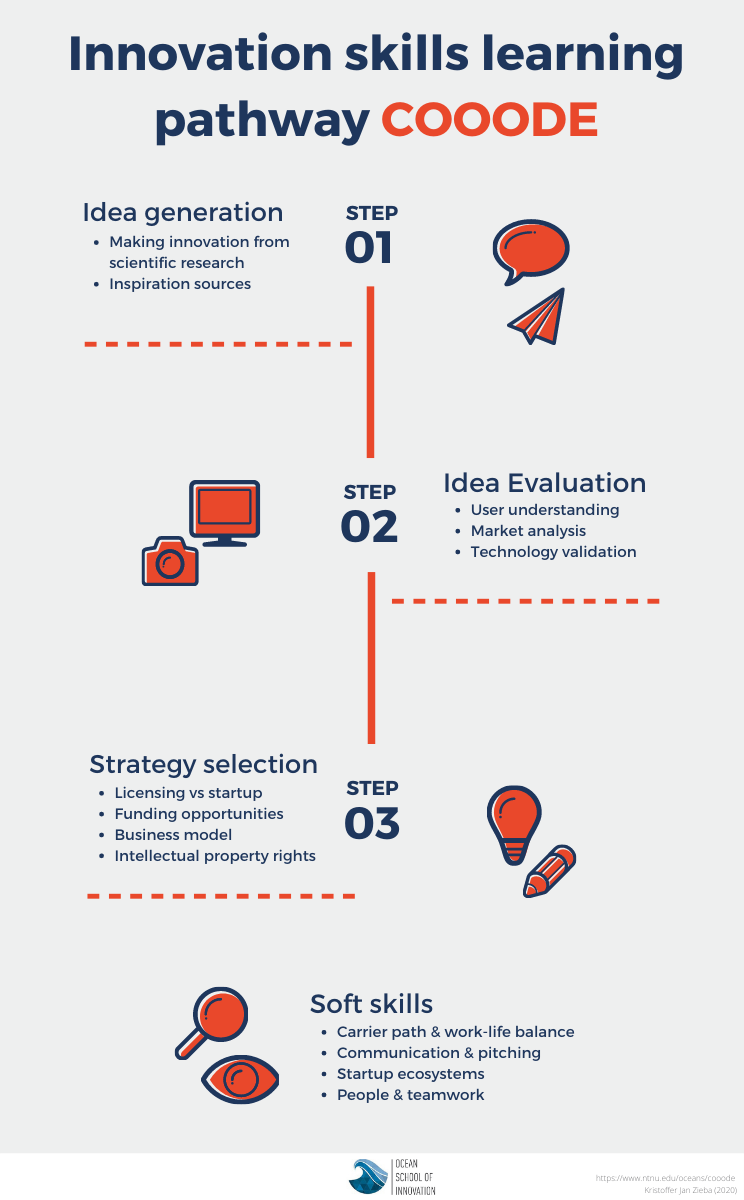
01 Idea generation

Idea generation
Making innovation from scientific research
Most academics go beyond production of at-the-moment useful technology and knowledge. They extend knowledge about the world around us, test unexplored technical possibilities and solutions that no one else would do. This is one of the main reasons why commercialization of knowledge and technology from a university is different than “normal” entrepreneurship or innovation process in corporate environment. University employees can however make use of experiences from outside the university – different approaches and techniques. Not all of them are however directly applicable to a university environment due to both type of knowledge/technology but also organizational differences. Therefore, academics need to critically evaluate recommendations and hints proposed by entrepreneurs and business to check if they really fit to their context.
Possibly one of the most important elements in this context for Norwegian academic entrepreneurs is that, as a rule of thumb, the intellectual property (IP, see 03 strategy selection) belong to a university (and sometimes external project funder) and not to inventors. Therefore, one of the first steps in the commercialization process should include contacting a university’s technology transfer office (TTO) to clarify the IP before performing any work including idea evaluation or strategy selection described in the next sections of COOODE. Work described in this section (01 Idea generation) is however very recommended to be done before contacting TTO because it will help refining a concrete idea that you will share and evaluate with TTO.
One of the most distinct differences in innovation processes between academic and entrepreneur/corporate environment is the source of innovation. For the world outside academia the main source is a need or problem from users and market. If clients demand a new solution or might like one, companies can create it and sell it. Some academics are also involved in this type of work – through research projects they create a technology/knowledge that private or public sector needs at the moment. In this case idea generation mostly covers finding a proper solution for a problem, and later business strategy. Many researchers however focus their efforts on “exploring unexplored” – the knowledge and technology that has no clear and direct application now but can have an extremely high importance in the future. If this is the case the idea generation process covers not only technical solution and business strategy but also finding application area for the research created, which most often, is not a straightforward task. This can however be solved by deeper analysis of the problem the research solves and alternative application areas (see inspiration sources).
Resources in this section
Inspiration sources
Creating a research-based innovation is about finding non-obvious connections between academic work and the world around. One of the most useful advices is to try to solve a real problem. This might be a problem that you know exists based on your work experience or someone else’s. When searching for ideas, look for them in areas where you have a real expertise. If you are professor in biology, do not try to build an app for teenagers. You would have greater chances to succeed using your real expertise than guessing what teenagers might want. Researchers have a great advantage here because they can solve niche problems that non-researchers cannot tackle due to lack of domain knowledge, experience, problem understanding and often specific user and marked understanding.
“When you find the right sort of problem, you should probably be able to describe it as obvious, at least to you (…). Which means, strangely enough, that coming up with startup ideas is a question of seeing the obvious. That suggests how weird this process is: you're trying to see things that are obvious, and yet that you hadn't seen. Since what you need to do here is loosen up your own mind, it may be best not to make too much of a direct frontal attack on the problem — i.e. to sit down and try to think of ideas. The best plan may be just to keep a background process running, looking for things that seem to be missing. Work on hard problems, driven mainly by curiosity, but have a second self watching over your shoulder, taking note of gaps and anomalies. Give yourself some time. You have a lot of control over the rate at which you turn yours into a prepared mind, but you have less control over the stimuli that spark ideas when they hit it (…). A good way to trick yourself into noticing ideas is to work on projects that seem like they'd be cool. If you do that, you'll naturally tend to build things that are missing. It wouldn't seem as interesting to build something that already existed.” - Paul Graham
One of the key activities of idea generation are discussions with potential users about their needs, present solutions and potential improvements (this can overlap with the next stage: 02 Idea evaluation). You may or may not share details about your idea depending on potential risk of losing your idea. But regardless of that get as much understanding about your potential users and the problem as you can. Do not focus on the work itself before speaking to the people – this will save a lot of your time. Maybe a problem appears to be the problem only for you? Maybe other solutions exist? Maybe other people will inspire you looking at the problem from different perspective?
Building a commonly recognizable innovation and company might seem tempting to many entrepreneurs but very often one can become a successful academic innovator by building a specialized product/service for smaller group of users. In addition, licensing of technology can also be a worth considering alternative (see 03 Strategy selection). Instead of building extremely ambitious startup ideas involving thousands of users, focus your work on involving smaller and specialized group of potential users. Start working with them and then think upscaling. This strategy worked out for many companies before such as Facebook or Airbnb that started as niche tools.
In resources section have a special look on TRIZ method if the problem and constraints are well known but the solution is not. This will be a very good starting point for these academics who work on well-defined problems and applied research. For these who are not certain about application area of their work yet, have a special look on Ocean School of Innovation’s ideation template that helps with refinement of the practical research application within and outside your field.
Resources in this section