
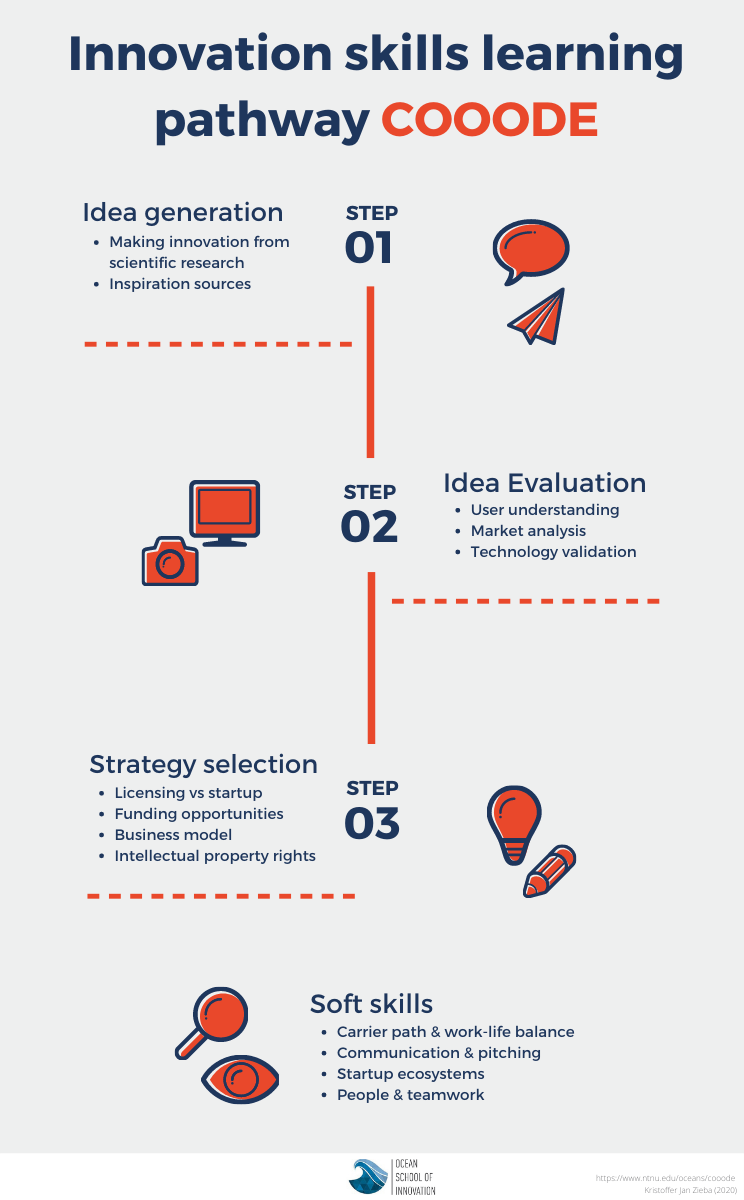
03 Strategy selection

Strategy selection
Let’s say you have already discovered something in your research that has a commercial potential outside your university, and you know there are potential users and marked for your innovation (you have gone through ideation, user and market research phases described before in COOODE). Now it is time for making some plan or a strategy to maximize chances of success. You should definitely have a sound idea about your plan on your own but being an employee at a Norwegian university it is normally not only you who makes decisions about commercialization strategy. It is also a university’s Technology Transfer Office (TTO) that represents interests of the university in commercialization of research (Norwegian universities normally own the intellectual rights to research results from their employees – including PhDs and postdocs). So, in short if you are up to commercialize your research contact your local TTO (see 01 Idea generation). TTOs have an experience with research commercialization and provides valuable input to the process. If you are not working on an idea developed at a Norwegian university you might also want to discuss the strategy with someone else who has certain experience, market insight and/or network. Here we will give you an absolute essence of what you should know and what might help in further discussions with other people involved in your project.
Licensing vs startup
They are multiple ways on how a research innovation can be brought to the world. They include for example different forms of dissemination, research-based recommendations and commercial activity. When it comes to commercialization, the most common ways are either establishing a new company– (a startup) or licensing technology directly to other companies. Here, we assume that you know what establishing a new company means but we explain a little bit the licensing part. By licensing, you as an owner or co-owner of an idea (often protected by e.g. patent), sell the permission to use your invention to another organization or business. You can sell an exclusive license that imply that your invention can be used only by the organization that has bought it. Or you can give “non-exclusive” right to use your invention. The second option gives you an opportunity to exploit your invention if you would like to start your own business as well as licensing out to more than one company. Licensing might be advantageous if you are not interested in starting up business on your own. Licensing will also be a preferable choice if your idea does not need years of development but can be transferred with no or little modifications to a client. Otherwise funding a startup would be a good alternative. Sometimes a certain market is dominated by few major players that are difficult to compete with and licensing the technology to these players makes more sense than competing with them. On the other hand, if market for your innovation is not well established or it does not exist, a startup option seems to be a natural choice. Licensing might also be less capital- and time-intensive because simply you do not need to build an organization around it. Nevertheless, if your idea needs some funding you may need to establish a company that gives you access to some funding sources (see Funding opportunities below).
Funding opportunities
Public funds
At early stages of an idea development, private investors or investment companies consider investment in a research-based idea to be a high-risk investment. Thus, to minimize their risk investors prefer to see their capital being supplemented with governmental or university funds. Therefore, for academic entrepreneurs the most natural choice for early funding would be public sources described in this section while private funding and crowdfunding (next sections) would be options for few. So, before you have a working prototype that can simply show that your idea is “implementable” and “realistic” consider applying for support from public funds first and use these resources to develop a prototype or a demo version of your innovation. Working prototype is a strong argument especially for private investors. It is also a proof that you can not only conceive an idea but also implement it – a good idea is just 5% of success other 95% is the implementation of the idea (for technology validation see 02 Idea evaluation).
At the beginning of innovation development many uses funding for technical validation (e.g. through building prototypes) and user and market research. User and market research are used to map out market opportunities and test different approaches for developing your product or service (for user and market see 02 Idea evaluation). Before you invest large amount of money, time and effort you want to be sure that there are people or organizations interested in paying for your innovation. When you have a working prototype and have established a preliminary vision of your target market you can start moving further and apply for the next stage of governmental support and at the same time start addressing private investors and investment companies.
Some of universities have funds aimed directly for research commercialization – both for technology and market validation. This type of funds might be the most natural at the beginning. Academic entrepreneurs may also consider financing initial technology validation by funds aimed for applied research and/or technology development. Such funds are offered by e.g. Research Council of Norway (Norges forskningsråd) through multiple programs. Early investments (seed funds) can also be financed by funds not exclusive for academia and research, for example these offered by Innovation Norway (Innovasjon Norge) through its programs. A registered company (in Norway AS) might be a requirement for some of the programs.
Private funds
When it comes to private investments, one of the most important matter is to find a single investor, investment company or industrial actor that fits both your needs and investor’s profile. It is not easy to secure private funds at early stages of idea commercialization when the investment risk is high. However, a most frequent reason for not getting private funds is lack of targeted approach rather than the innovation itself.
Private investors as well as investment companies use an investment portfolio for making their decisions. Before you address a private investor, it is important to do a thorough homework and study what kind of products or services this particular investor has been investing before. You need to make sure that your idea lies in a scope of professional or personal interest of an investor. Keep in mind that majority of private investors prefer to invest in solutions of technical areas that they are familiar with and often had previous working experience. Although some private investors invest in ideas that can solve problems they personally care for.
Another option for financing development of research-based innovation are industry-sponsored research projects. Companies may want to sponsor the development process because of many reasons. For example, they want to acquire your technology before their competitors, get access to the technology for cheaper price, develop their know-how by collaborating with you, or have some unused R&D resources in their budget. Such projects may be fully or partly financed by industry. In the second case, the remaining part is usually covered by public funds.
Crowdfunding
Crowdfunding is another, and maybe not the most intuitive, option to fund your project. Simply speaking crowdfunding is a concept that allows many investors (often non-professional ones) to invest small amount of money into ventures they believe in. Crowdfunding could be seen from two perspectives: as a funding opportunity but also as a good early-market test if your innovation is interesting for broad public. Crowdfunding might work especially well with innovations that are interesting and easy to understand for majority. However, if your idea is applicable for a small group of specialized users, the crowdfunding option might not be the most efficient way to go. Another thing to consider is a potential risk of copying of your idea by someone else.
There are three general types of crowdfunding: reward-based, equity-based and donation. Reward based crowdfunding typically implies that “an investor” gets a product as a reward for his/her investments. Thus, such crowdfunding campaigns are often referred to as “pre order” campaign. Even though reward-based crowdfunding is considered as an investment it does not provide investors with any financial or equity return and often considered a sub-type of donation crowdfunding. Equity-based crowdfunding is similar to traditional private investment with the difference that instead of selling your shares to one investor or investment company you sell many small shares to many investors – the crowd. In this case, equity owners receive financial return on their investment.
In crowdfunding, choice of a platform is as important as choice of private investor. If your innovation is aimed for international market and the biggest markets – let’s say the USA, you should launch you campaign in internationally recognized platforms such as Kickstarter or Indiegogo. On the other hand, if you have developed something that has a regional importance, you should consider launching you campaign on local platforms.
Resources in this section
Business model
When you have decided on the initial course of action for exploiting your idea, it is time to think about a business model. In simple words, a business model summarizes all your strategy, describes the way you want to organize your business and how you plan to earn money from your idea. The business model shows if all of your ideas about your business fit and make sense together and it is a great tool for detection of potential weak points in your plan. One of the most popular ways to organize a business model is a framework called “Business Model Canvas”.

The canvas consists of nine main blocks, each describing different aspect of your business. You should develop and fill your business model canvas in a certain order – the same order as it is described in the text below. In addition to text below information from 02 Idea evaluation might be useful for completing the canvas and building your business model.
First and central building block of your business model is called ‘value propositions’. Value propositions describe what value your innovation brings to your customers, or in other words what customer problem your product or service solves and in what way. Here, it is important to understand difference between a simple description of characteristics of your product/service and the value proposition. For example, if you are a mobile phone brand, your product is the phone, but your value proposition is the connection it provides between a user and people the user wants to be accessible for. On the other hand a smartphone has wider value proposition, because it not only connects a user with others but also gives access to wide information sources (through internet) and many other tools, such as calendar to plan, apps to buy buss tickets or pay for parking, etc. When you have established your value proposition clearly, you know the requirements your product must cover or satisfy.
The next step is to define key resources that are needed to create your product/service and deliver it to the potential customers. If we continue with the same example, what resources do you need to produce and sell a smartphone? They can be a specific inventory, equipment, employees that possess specific knowledge, etc. Now you know what outcome you are aiming for and what resources you need to acquire to get the desired outcome. Then it is time to figure out what actions or key activities do you need to perform with your resources (for a smart phone you may need, e.g. raw materials) in order to produce the desirable outcome and deliver it to your customer. Key activities involve the technical side including development and production of the technology, and the business side including customers, expanding your market, investments, etc.
The business might often be dependent on other organizations and people. Thus, it is important to recognize key partners that can help you run your business effectively. Coming back to our example with a smartphone brand, the key partner might be a producer of touch screens or someone else depending on what you are missing in-house.
The next important building block of your business model describes who are your customers and how you plan to build relationships with them. Here, the first thing to determine is what are your customer segments. Nascent entrepreneurs often make a mistake of defining their customer segment as “everyone”. One can claim that a smartphone is something that everyone needs. But remember that you are not alone in the market, and people are different. Not everyone needs, wants or can afford a smartphone, thus your market is not everyone. For example, even though iPhone, Nokia and Huawei are all smartphones, they have different value propositions and different customer segments.
Based on your customer segment, you define how you are building customer relationships and what channels you use to reach you customer in the most convenient way. For example, if you see that your customer segment is young people, you would most probably choose social media as a channel to reach you customer and not a TV or paperback newspaper.
The last but not least important building block of your business model describes the financial part of your business including cost structure and revenue streams. Cost structure include your costs, e.g. salaries for employees, expenses for outsourcing, partner fees, marketing, etc. Revenue streams describe for what exactly and how your customers pay.
As you can see, business model focuses most on internal characteristics of your business. At the same time, it recognizes role of external factors such as partners and customers. Even though market and competition are not an explicit part of the business model, success of your business model is heavily influenced by the external environment where your business will operate. Therefore, make sure to consider market conditions and competition while designing your business model. And remember that it is not only your innovation that can bring you the revenues. A suitable business model can be a decisive thing when it comes to a failure or success in the market.
Resources in this section
Intellectual property rights
Starting a new company is much like maneuvering through a jungle. It is easy to get lost and different dangers are lurking. When it comes to intellectual property (IP) there are a few things your need to be aware of; what is sensitive information of your idea, how and with whom do you share these with? Most of the research results represent IP and to some extend they are automatically protected (see copyright). Nevertheless, research dissemination is normally not protected from being used in commercial activity of someone else. Thus, if you want to commercialize your research on your own, you need to find out a way on how to protect your IP. For Norwegian academics it is a university’s technology transfer office (TTO) that manages intellectual property on the university’s behalf. In such cases it is TTO that makes sure you have solid agreements with collaborators that clearly states the ownership of IP of your idea. IP protection strategy is also a one of the major tasks of a TTO, but your input as an inventor and domain specialist in building the strategy is important.
Strategy
The main priority of any start-up should be the business strategy. At the same time, you should be aware of IP and how it supports commercialization objectives. The strategy will outline the direction you want to go, IP will help you get there!
IP Protection
Intellectual property alone will not make your idea succeed. The key to success lay in how you manage and utilize your core assets and IP. With a limited budget, registering rights such as patents, may not, or even should not, be a main priority. As we will highlight in this handbook, there are other alternatives. However, keep in mind that your idea will grow, and with it your need and requirements for protection. Throughout your business development, you must not do anything that will limit or compromise your ability to upgrade your protection plan when the time is right.
Ownership
As a starting point you should know the IP assets you (or your university) possess and establish ownership of these assets in all your relations. Ownership of IP should be clearly documented in writing, with employees in an employee contract and with contractors, consultants, collaborators etc. with an NDA (non-disclosure agreement). See NDA.
Brand
Your idea, future brand and reputation are one of your future company’s core assets. Your standing in the market is connected to your reputation and is directly linked to how much you are able to charge for your products and services. Why customers choose your products over your competitors is linked to your brand and what your customers associate with your name. One way to build a strong brand is through good values, social responsibility and good customer service to mention but a few. Building a strong brand is a long process and is no straight forward matter. Registering a trademark and logo is one way to protect your brand.
Infringement search
Stepping on someone’s toes could be more painful for you than the for the one the toes belong to. Intellectual property disputes are costly and should therefore be avoided. Before you spend too much time and money on your new business idea, make sure that you are not infringing on existing patents, trademarks or registered designs. Start with an online search at patentstyret.no to get an overview of what is “out there”. Before applying for legal protection, such as patents, seek professional help! At Norwegian universities they are technology transfer offices (TTOs) that protect innovations/ideas on behalf of the universities. In such cases university's employees need to take contact with a TTO first. In other cases, Innovation Norway (Innovasjon Norge) might also be a good place to start.
Be Aware! Solutions, designs, names, logos, slogan etc. that are too similar to existing rights may prevent you from obtaining legal protection. Also, all published information will dispute the novelty of your solution or design, hence be an obstacle to obtaining legal rights.
Trademark
Your idea’s name and logo are what your customers know you by. Make sure you (or your university) own the rights to your own name so no one can take advantage of the time and effort you have spent building your name and reputation. Registering your trademark is neither time consuming nor costly, and it is done online through altinn.no
Be Aware! First make sure that the name or logo you wish to register is not in use by others. Also make sure that there are no existing trademarks or logos than may be confused with your own. Your trademark must be registered locally in all relevant countries. When registering internationally, make sure that your trademark does not mean anything else in another language. For example, Barf Detergent (snow detergent) from Iran and Pee Cola (very good cola) from Ghana. You don’t want your international customers getting the wrong associations.
Patent
A patent is an exclusive right to commercially exploit an invention. The patent will protect the solution to a technical problem, not the idea itself. A patent may give you a competitive advantage over your competitors. However, gaining, maintaining and defending a patent is both costly and time-consuming.
Be Aware! Keep in mind that once you have publicly spoken about your idea, you have ruined your chances for a patent protection. So keep your cards close at heart and be careful of whom you share information with. It is sometimes necessary to discuss or collaborate about an idea, but this should not be done without an NDA. See NDA
A patent might not be the right way to go. You need to consider your financial situation, practice within your industry, life span of your product to name but a few. More importantly you need to consider the purpose of the patent. What do you want to achieve? An alternative to a patent application is to disclose as little as possible. See Trade Secrets.
Design
A design registration gives you an exclusive right to commercially exploit a particular design. Registered design refers to the visual appearance of the product or its external packaging. This may be shapes, patterns, ornamentations and configurations. Materials used cannot be protected. The design must be significantly different from other designs on the market.
Be Aware! Designs rights are territorial in nature and must be registered in each country of interest.
Copyright
Copyright protects artistic works such as literature, movies, pictures and music. The copyright gives you the right to control your work and be named as the creator. Although copyright is considered to be a “lighter” protection than other registered protection such as patent, design and trademark, it is a way to protect ownership of for example software and webpages.
Be Aware! No formal registration is needed. Protection is obtained from the moment of creation and up to 70 years after the death of the creator. Note that copyright protects the work itself, but not the idea, discovery, method, procedure or logic behind it.
Trade Secrets
A trade secret is confidential business information with a financial or strategic value that has been kept secret. Examples of trade secrets may be market knowledge, databases, customer lists and information on ideas and innovation etc. Keeping a process or a product confidential may be the best intellectual property protection. However, it requires loyal employees and business partner.
Be Aware! Trade secrets are only protected as long as they are kept secret. Once the cat is out of the bag, there are little you can do to mend any damage.
NDA
A confidentiality agreement is often referred to as a non-disclosure agreement (NDA). Through an NDA you establish ownership of IP and an obligation to keep information confidential. An NDA should be signed with anyone who you need to share confidential information with. Make a conscious decision on what information you can and cannot share; what information need protection.
Be Aware! Even with an NDA, there is always a risk that sensitive information may be leaked. So share as little as possible and make sure that the person signing the NDA have the right authorization to sign such agreements.
Resources in this section
Curious? Contact the authors
 |
Magnus Hakvåg CEO +47-41306634 magnus.hakvag@hakvag.no House of Knowledge |