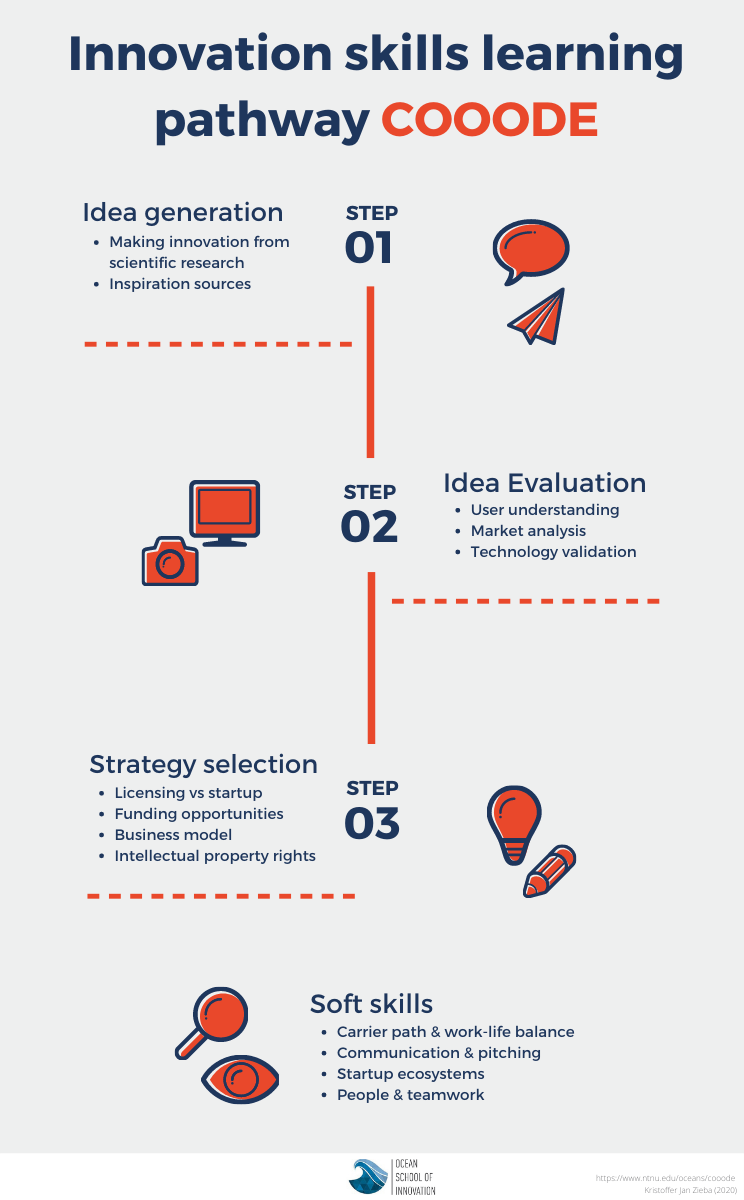
Soft skills

Soft skills
Carrier path and work-life balance
Usually academics consider two main carrier paths: in the academia and outside the academia (including the private and public sectors). There is however another option that is not the most obvious one and stands in between of these two traditional choices: carrier of an “academic entrepreneur”.
In short, academic entrepreneurs have their feet in two worlds: in the academia and in the world outside university. They share their time for technical-scientific work (academic component) in addition to application of innovations in form of new companies or in the industry/public sector (entrepreneur component). Such a combination requires a wide range of skills that academic entrepreneurs need to, sooner or later, learn (see article in the resources section: “The Third Way: Becoming an Academic Entrepreneur” – Science).

Carrier path of an academic entrepreneur is far from being a blind way. Academic entrepreneurs do not discard neither academic nor non-academic options. They rather split their time for academic/scientific-, technology development- and business-related activities leaving two doors open for the future. Perhaps, some academics might argue that less time devoted to purely academic activities such as writing and teaching might not be favorable for their future academic carrier. In some cases, this might be true, but on the other hand innovation work can be beneficial for the academic carrier – innovation work creates new ideas and pathways for research and science. This is often the case because scientific ideas are become verified in the real life. Prototyping and user feedback rounds might generate improvements of the existing idea as well as generate new technological or scientific ideas.

Experience from entrepreneurial role might be in a great advantage for academics who want to pursue future carriers in industry or public sector. Not all of the academic work is perceived as “relevant” and “practical” one outside universities. Many researchers struggle with showing their practical skills and user-oriented mindset to employers outside the academia. Here entrepreneurship experience might help because it shows these practical and applied skills.
Resources in this section
Communication and pitching
You may expect to communicate your idea from day one because it is one of the most vital elements of the entire process. Presenting and pitching is absolutely not limited to discussions with investors at the later stages of development. In addition to formal presentations, informal communication and pitching are these elements that really need to be mastered by academic entrepreneurs. Every formal or informal conversation about your idea with your colleague, friend or a stranger is a chance for a feedback, collaboration, financing and so on.
But yes – it is hard to be both technically precise and to be able to share your enthusiasm in the beginning. It is usually difficult when an idea has its source in the research – you know you are onto something or have a very initial idea, but you are not sure what the final outcome will be. So, what is the solution? In short, you need to prepare. For most cases, you need to prepare your informal pitch first to be able to communicate with the world around you, and then make a formal pitch/presentation when you need it (e.g. for the first meeting with university’s transfer office or for a collaboration partner).
It might not seem necessary, but you need to allocate time for preparation of your informal pitch and spend some time evaluating the elements you include. First, you may prepare a talk that does not take more than 30 seconds. A classic approach is to present following elements in following order: 1) what is the problem that world/specific group of people/industry have? 2) What are present-day solutions for this problem (if any)? 3) What is your solution (very briefly)? 4) Why is your solution better than the existing ones and what positive change will it bring? The next step is to learn the pitch and test it on many people with different backgrounds. Of course, you want to spread interest, but do not overdo it - do not turn into a pushy seller or a person you are not. Be flexible – do not learn the pitch by heart. Let other people interact. You may need to emphasize different elements depending on who you speak with. Be prepared to tell more details if people are interested. You should also expect being invited for a longer discussion. Possible details and extensions also require preparations or to have some ideas ready in your head. A good pitch is a pitch that has been tested on many people and evolved through time.
At some point you would present your idea on a formal meeting. This might also be a pitch, discussion or a slide presentation. You may consider the same elements and logic as the short oral pitch. Many good advises can be found in the resources section, but in short, the most important take-home message is to adjust your presentation to the audience and background of the people you speak with. For example, your presentation will be different for investors and different for a technical partner who you want to collaborate with. For investors you may want to emphasize impact of your innovation and expected revenues keeping the technical details to minimum. On the other hand, technical collaboration partner might be interested in speaking about your technology and getting to know what he/she will get out of the collaboration. So, get to know your audience beforehand and adjust the presentation accordingly. You may also want to ask what their interests are before the meeting. If you do not know your audience make a zero assumption about their background knowledge – technology, science or business. Do not expect something is a common knowledge or they should know this and that from their education. On the other hand, if you see your audience already know the basics, skip them and provide some extra information instead in order to fill the entire time you have.
Generally, it is very beneficial to speak about your ideas to raise interest, get feedback, new partners and so on. In some cases, however it is not a good idea to share more than absolutely necessary. If you are concerned your idea can be taken from you, keep your pitch simple and avoid details. It is a good idea to get in contact with a university’s technology transfer office for advice. For example, they can give you information on patentability of the idea and what type of communication might violate the patenting process. For some formal meetings it is possible to require the signing of a non-disclosure agreement (NDA) that legally protects your idea (see Intellectual property rights in 03 Strategy selection).
Resources in this section
Startup ecosystems
Startup ecosystems are communities of people working either as entrepreneurs, supporting actors or providers. They have different sizes. We can speak about small-scale ecosystems (e.g. a university startup ecosystem), regional-scale ones (e.g. Silicon Valley ecosystem) or large-scale ecosystems including national ones. Regardless of the size, they often consist of inventors, established startups and entrepreneurs, advisors, investors and businesspeople. Ecosystems can include one or more organizations like universities, incubators, accelerators, venture-capital companies and coworking spaces. Ecosystems are considered to incorporate other elements: research, ideas, capital, events, meetups, portals, blogs and social networks and so on. Academic entrepreneurs have often some access to a university or regional ecosystem. Entrepreneurial communities and ecosystems can definitely boost development of your project and are great sources of:
- Inspiration that can boost your technical and business development or business ideas.
- Information that is not well-available if you are not in. They may be sources of funding, new accelerator programs and so on.
- New collaborators, team-members and competences that you might need on your way.
- Case examples – you may hear good stories of which pathway or solution has worked out and what has not.
- Good time and mental support – having a group of people that chose similar carrier pathway can mean a lot.
But how to navigate through so many opportunities? Which one to choose? There is no one simple answer here – each ecosystem is unique, and your situation is unique as well. In some locations, ecosystems are well-developed and in some not. In some places you can find many opportunities and large community but in some places the offer is limited. In some cases, it is almost a must to interact and join a formal community. For example, if you need many resources or you need to make your idea visible now. In other cases, it is more advantageous to focus on the groundwork and limit interaction with the ecosystem. It is a matter of timing as well – you need to consider if an ecosystem offer is what you need at the moment or will it be something useful in some years ahead. To make it short, they are many variables to be taken into account when interaction with a local ecosystem is considered. Possibly the best advice might be to evaluate pros and cons and discuss your options first with all people involved in your project (e.g. team members, TTO).
People and teamwork
In most cases you are not the sole inventor. Often it is an effort by you and your colleagues. Sometimes your idea is based on past research and ideas of other people. It is definitely an important decision who to involve in a project development team. In some cases, it is advantageous not to involve many parties. On the other hand, the development of an innovation by your own or in a very small team might lead to very long development time and your project might suffer from lack of necessary competences, new impulses and energy.
People can bring a lot of great input to a project – their knowledge, know-how, network and recognizable names that “legitimizes” the project. People can interact with you and your project on different premises and roles. The most frequent roles are co-founders, team-members, mentors and “innovation champions” (people from outside your organization that are passionate about an innovation and will help pursuing it).
People are possibly the greatest capital in innovative projects. This is why investors often base their decisions to invest in a startup on team characteristics – skills, knowledge and spirit. So possibly a take-home message would be to choose specialists in their field but also people you trust and will work great with in the future.
Resources in this section
Curious? Contact the author