Bubbles
Bubbles - Some reflections by a PhD candidate

What would be the first thing that comes to your mind when you hear the word “bubbles”?
Most people, including me, will probably spontaneously think of their childhood memories of blowing bubbles from a liquid made of soap. These bubbles, with their light and playful nature, floated in air, shimmering and popping effortlessly.
So how come did these child-friendly entities became the focus of my PhD degree?
Well, bubbles are simple in form, but intricate in science and impactful in life. Witnessing how they reveal their secrets, their role in nature, and their surprising applications in technology, art, and beyond, deeply engage me.
In the texts below, you can learn more about bubbles and my research.
Read more about bubbles in our published articles:
For more information on our research activities, please visit our team's webpage: FluTP - Fluid Transport Phenomena
Bubbles in Everyday Life
Bubbles in Everyday Life
Bubbles, those mesmerizing gas spheres wrapped in a thin liquid film, poses an allure that transcends their simple form. From the fizz in your soda to the shimmering foam on ocean waves, bubbles are ubiquitous in our daily lives. They can even be found within our own bodies!
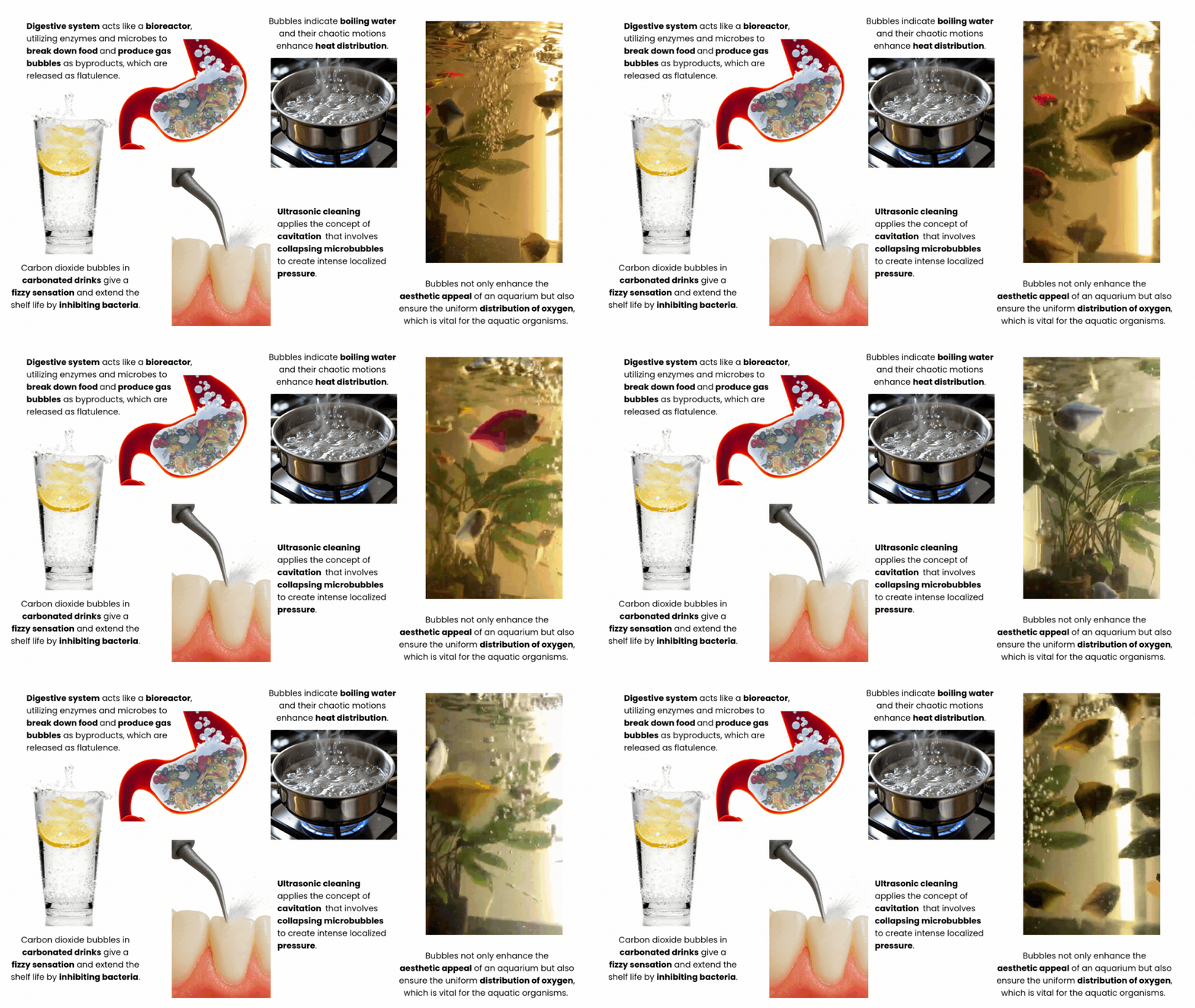
Given the broad spectrum of these applications, understanding the dynamics of bubbles within complex systems is important for optimizing the process efficiency across various fields, including industrial, environmental, medical, and energy sectors.
Our research involves both numerical and experimental investigations on bubble hydrodynamics and interfacial mass transfer. Through these investigations, we aim to deepen our understanding on complex multiphase flow systems to come up with effective strategies for optimizing the design and operation of biochemical reactors.
The Bubble's Journey: An Analogy to Human Life
The Bubble's Journey: An Analogy to Human Life

When bubbles are present in a liquid, they rise to the liquid surface, only to vanish in an instant. Their journey may be brief, but their complex dynamics during their rise contain a meaningful lesson. Likewise, perhaps life isn’t about how long we last, but how we grow, evolve, and reflect along the way.
The dynamics of a bubble depend on the surrounding conditions, including the liquid properties, flow conditions, and the presence (or absence) of specific substances. Bubble shape, for example, tend to stay spherical when the bubble size is relatively small. This bubble also rises more slowly compared to larger bubbles.
Scientifically, the bubble deformation can be explained by two competing forces: the surface tension force and the viscous force. Like its name, the surface tension force represents the tension between the gas and the liquid phases which holds the stability of the bubble shape. This tension only needs to hold a smaller surface area when the bubble size is smaller. In other words, this energy is responsible for maintaining the bubble's sphericity. On the other hand, the viscous force comes from the tendency of the liquid to resist the bubble motion. When a bubble rises while the liquid stay stagnant, it creates a relative velocity between the bubble and its surrounding liquid, which causes the bubble to deform to some extent.
So how do these phenomena relate to human life?
A deep lesson behind bubble breakup
Bubbles remain spherical when the surface tension force is greater than the viscous force. This concept resembles the inner strength of someone’s resilience to face life's challenges. As the bubble size increases, its shape also becomes more susceptible to deformation, just like how humans have more challenges when they get a bigger responsibility. When the bubble size is too large for the tension to hold, it may deform extensively and even break apart. Likewise, when someone has too much responsibility to handle, their internal condition may break apart, either physically or mentally. Delegating some part of the responsibility could be an ideal solution. However, realistically, this is not always the case. It is therefore important to sometimes release the perfectionism.
Enjoy the journey
The same stress level can be analogous to the bubble rising speed, which increases with its sizes. Thanks to the buoyancy – an upward force emerging due to the gas being lighter than the liquid. The upward speed is further determined by the Law of Archimedes, increasing with the bubble volume. It is interesting to connect this concept with how we enjoy our lives. When we have too much responsibility, we tend to move ahead and forget to enjoy the process. When the bubble gets even larger enough to trigger a path instability, which causes the bubble to rise in either helical or zigzag instead of a linear path, its speed is reduced, not because it ‘enjoys’ the process but because it encounters an even longer trajectory than a linear path. As we delegate the responsibility, or release our perfectionism (mass transfer), the stress level is reduced (shrinking bubble), our internal condition is stabilized (more spherical shape), our efforts are more efficient (more linear trajectory), and we tend to enjoy the process more (slower speed).
Lead a happy life in this imperfect world
Whether delegating the responsibility or releasing the perfectionism, these attempts are just like the nature of interfacial mass transfer phenomena, where the gas species from the bubble may dissolve into the liquid. This happens when the species concentration in the bubble is higher than the one in the liquid. As this phenomenon progresses, the bubble shrinks more and more until the size is small enough to return its shape to a perfect sphere again. Correspondingly, as the bubble becomes smaller and smaller, the rising speed is getting slower compared to larger bubbles. This represents how much you can enjoy your journey, whether you’re carrying less responsibility, or more impressively, when you're able to let go of unnecessary worries and maintain your joy and balance even under heavier duties.
The concept of mass transfer is not only analogous to delegating responsibility or releasing perfectionism, but also transferring a positive vibe. Remember that this phenomenon only occurs when the species concentration in the bubble is higher than the surrounding liquid. When someone lacks positive energy after a long day, sometimes, we can transfer ours through motivating, comforting, or inspiring words, or even just a sincere smile.
Then, how if we end up losing our own energy? Theoretically, continuous mass transfer should cause the bubbles to disappear completely. Interestingly, our experiments show that the mass transfer stops after some time, leaving the bubble to stay present at a constant size. There have been many scientists trying to justify this unique phenomenon, but there is no exact reason that is convincing enough to prove the argument. Our recent publication indicates that a small amount of contaminants in the liquid may accumulate at the bubble interface, and becomes more compact as the bubble shrinks during its rise. We could interpret this as: no matter how much positive energy we transfer to others, we always still have it remaining within us. A particular case, when there are external forces, like mixing, exerted to the system. These forces can hold the bubble longer in the liquid and promote further mass transfer until the bubble disappears completely. Perhaps, we can relate this to a crisis of identity, which is therefore it is important to build a strong principle within us as we grow older, set our boundaries and stay to our true character, so that we are not easily shaken by the dynamics of our environment.
Bubble interaction vs. social network
Just as bubbles interact with each other, humans grow and build networks within society. Each interaction, like the collision and coalescence of bubbles that alter their dynamics, develops our relationships, shapes our attitude, and influences our paths. Some bubbles rise individually to the surface and stand out, while others cluster together. In the same way, we sometimes lead our lives independently and at other times form connections, adapting and evolving as we grow through our life.
Inspiring bubbles as self-reflection
No matter how complex the dynamics of bubbles are - how frequently they break apart, how unpredictable their movement from one group to another, or even how they sometimes move alone - they consistently rise to the surface because they are lighter than the surrounding liquid. Inspired by the nature of these bubbles, let’s embrace our own nature as a human: to move forward no matter what. These bubbles are the silent witness to our life journey, filled with joys, sorrows, and everything in between, revealing not only our flaws and imperfections but also our strength and resilience.
When the moment comes to let go, it is not an end but a transformation. Until finally, when the bubble reaches its destination at the liquid surface, it is not a complete disappearance. It is just returning back to where it belongs to – the atmosphere –, after leaving behind a trace of hints to meaningful scientific phenomena.
The Science of Bubbles: How Tiny Interfaces Play a Big Role
The Science of Bubbles: How Tiny Interfaces Play a Big Role
When you blow a liquid of soap to create bubbles, you can play around with two options: creating multiple small bubbles, or making one large bubble. Then, you will notice that small bubbles tend to maintain their sphericity, while large bubbles may deform more extensively as they float away. How do scientists and engineers interpret these phenomena?
Bubbles may seem like a clear vulnerable layer, but they don’t collapse or disappear so easily. Despite their thin surface, bubbles store energy that helps maintain their spherical shape. The dynamics of this energy is one of the most interesting phenomena that captures the attention of the scientific community. Indeed, it is relatively easier to predict process efficiency when bubbles are stable and spherical due to their straightforward behaviors, though this is often not realistic.
Understanding the Dynamics of Bubbles in Complex Multiphase Systems
The behavior of bubbles in complex liquids is influenced by multiple factors, including fluid viscosity, surface tension, and external forces like turbulence. When they interact, they can merge into larger bubbles or break into smaller ones. These interactions are crucial for processes like separation or chemical reactions, which rely on the optimal size and population of bubbles.
In separation processes, larger bubbles are often preferred since they rise more quickly while carrying the unwanted species out of the liquid phase. In this case, having the bubbles merged to form larger bubbles is preferable. Meanwhile, smaller bubbles are typically more advantageous for mass transfer processes since they provide a larger surface area for a given volume (imagine the total surface area in your choices between creating multiple small bubbles or one large bubble). Therefore, bubble breakup is often induced for these processes. However, if the bubbles get too tiny, they might get trapped in the liquid, taking up the space without actually improving the overall efficiency.
Our research reveals that the efficiency of mass transfer is higher for smaller bubbles only a few seconds, after which larger bubbles become more efficient. Advancing our understanding on these dynamics may open the door for innovative solutions across various complex systems, even far beyond industrial applications. In environmental science, for example, bubbles are present in the ocean and affect the gas exchange, including carbon dioxide and oxygen levels, which in turn influences the climate. Similarly, in medical applications, microbubbles are being developed for targeted drug delivery and ultrasound imaging to enhance the therapeutic outcomes.

The Art of Bubbles: Creativity Knows No Bounds
The Art of Bubbles: Creativity Knows No Bounds
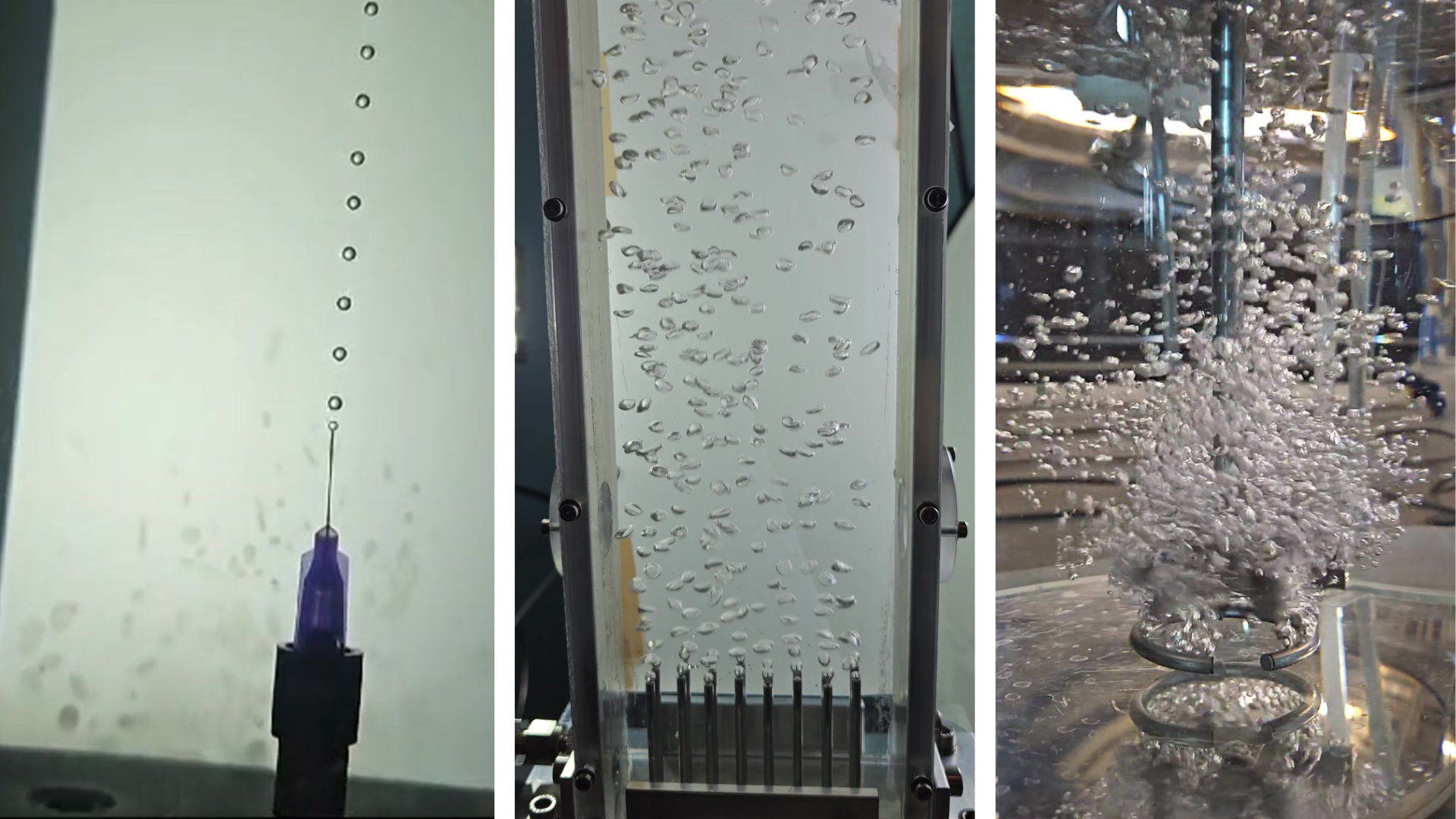
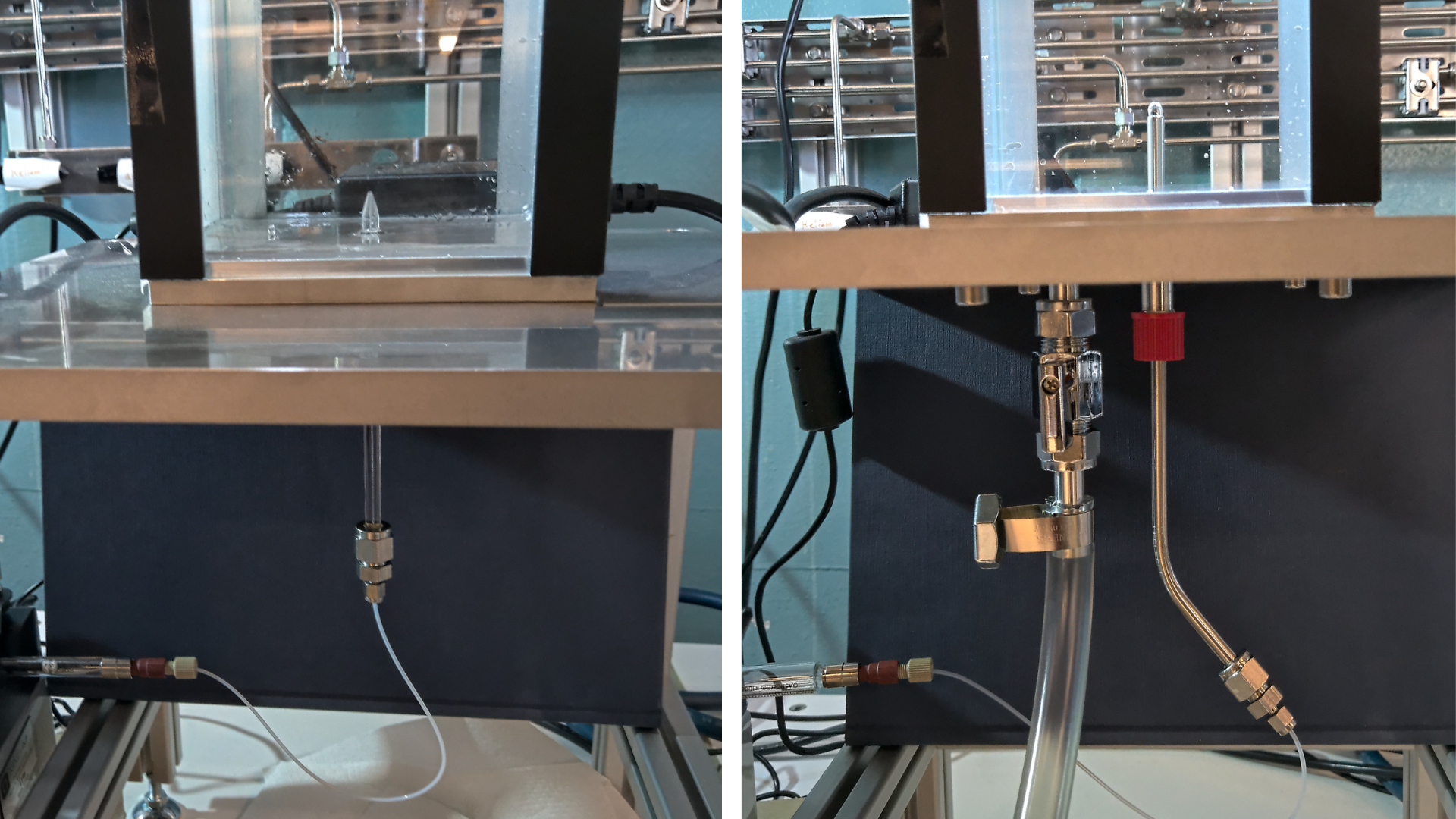
In our pilot-scale laboratory, we blend creativity with science to carefully design experimental configurations for bubble columns and stirred tanks. Every element, from bubble injection setups to customized stirrers, is crafted to meet the desired experimental conditions.
Despite encountering numerous challenges in generating a large single bubble with various needle designs, inspiration came into mind unexpectedly. The moment I set aside my overwhelming thoughts and enjoyed a glass of iced tea with a metal straw, I realized that the metal straw could be adapted for my experimental setup, and to my delight, it proved successful!
Design, Photography, and Visualization
When capturing the bubble evolution, photography transforms into art through precise lighting adjustments, thoughtful composition, and accurate focus. Each detail, from capturing the perfect moment of the bubble behavior to enhancing color and contrast, contributes to the visual impact.
Likewise, we utilize advanced simulation techniques to visualize and analyze the bubble behavior, turning scientific data into captivating visual representations that merge science with art.

Bubbles in Engineering: From Bubble Columns to Stirred Tanks
Bubbles in Engineering: From Bubble Columns to Stirred Tanks
Bubbles may seem simple, but in engineering, they play a crucial role in everything from chemical reactors to wastewater treatment. Whether in bubble columns or stirred tanks, understanding how bubbles behave can make industrial processes more efficient and sustainable.
Bubble Columns: Rising Bubbles for Mixing and Reaction
In a bubble column, gas is introduced at the bottom of a liquid-filled column, creating a rising stream of bubbles. The motion of these bubbles stirs the surrounding liquid, enhancing the gas–liquid mass transfer and promoting the mixing within the liquid phase. These characteristics make bubble columns ideal for chemical reactions, bioreactors, and gas absorption. The design of these columns depends on factors like bubble size, gas holdup, and flow regime, which influence the efficiency of gas dissolution and its interaction with the liquid phase.
Stirred Tanks: Bubbles Under Shear Forces
In a stirred tank, bubbles don’t just rise naturally - they are broken up and dispersed by an impeller. This added shear force creates smaller bubbles, increasing the surface area for mass transfer. Stirred tanks are commonly used in biotechnology, pharmaceuticals, and food processing, where precise control over gas-liquid interactions is needed.
Why Do Engineers Study Bubbles?
The efficiency of processes like fermentation, hydrogen production, and carbon capture depends on how well bubbles transfer gases into liquids. Engineers study bubble dynamics, coalescence, and breakup mechanisms to optimize industrial systems and reduce energy consumption.
From the delicate rise of bubbles in a column to their chaotic dispersion in a stirred tank, these tiny pockets of gas hold the key to some of the most important processes in modern engineering.