
Strategy for the Faculty of Engineering
Strategy 2026-2035

Vision: Knowledge for a better world
For the Faculty of Engineering, Knowledge for a better world means using our expertise to drive technological development, create sustainable solutions, promote value creation and shape the future through research, education and innovation.
We shall develop knowledge in accordance with the norms of society and science, for the common good.
Social Mission
Society's needs
Since the Industrial Revolution, engineering has played a key role in societal development and has enabled a level of prosperity unparalleled in world history. At the same time, this development has led to sustainability challenges.
Society’s need for engineering expertise is evolving in step with the demands and changes we face today. The transition to a sustainable, zero-emission society requires new knowledge, technology and innovation to drive future value creation. Norway still has abundant natural resources and must utilise them in a sustainable manner. Adapting to climate change and the need for resilient infrastructure present new challenges. The green shift requires land and resources, and we must find solutions that also safeguard biodiversity. A changing security policy landscape places greater expectations on engineering’s contribution to civil protection. Artificial intelligence and quantum technology offer great opportunities, but require responsible development and management. Society places high demands on engineering science, and we take our responsibility seriously.
The Faculty of Engineering’s social mission
The Faculty of Engineering at NTNU plays a key role in the university’s scientific and technological profile. Our social mission is to develop, manage and make engineering knowledge accessible in order to ensure future value creation and sustainable global development. We ensure high international standards in research, education and dissemination through interdisciplinary collaboration with other faculties, internationally recognised institutions and national stakeholders. Communicating our activities is important and must be based on academic freedom. The Faculty of Engineering has a special responsibility to develop, manage, educate and disseminate knowledge that contributes to:

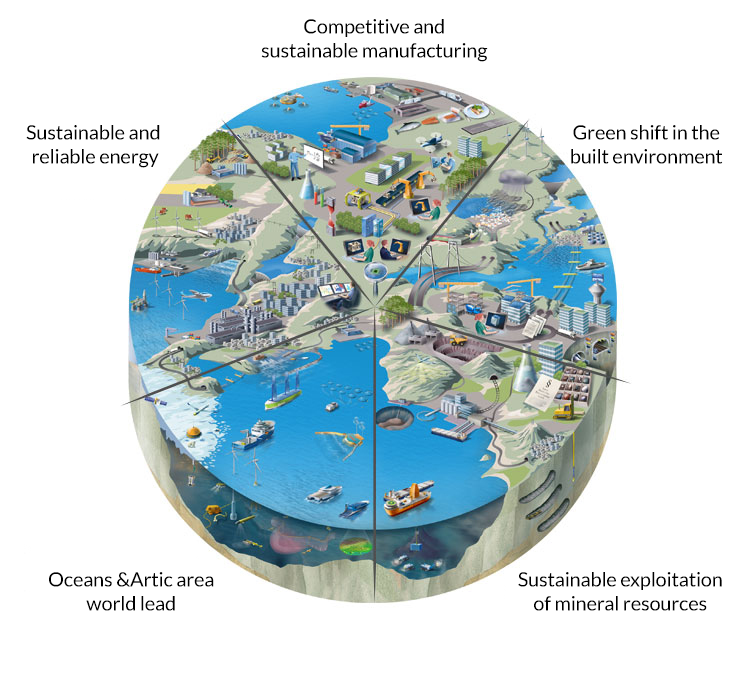
All five of our academic domains (civil engineering, manufacturing, energy, geosciences and marine technology) require expertise across a wide range of disciplines, including sustainability, project management, safety, reliability and maintenance, as well as enabling technologies such as digitalisation, materials technology and nanotechnology. The Faculty of Engineering actively promotes the necessary transformation within its academic domains, with a particular focus on developing educational programmes that integrate comprehensive sustainability and digitalisation expertise.
Content
Department Strategies at IV
Related resources
Ambition 1: The Faculty of Engineering is outstanding both nationally and internationally
Research, education and infrastructure at the Faculty of Engineering shall be outstanding and maintain a high international standard. We shall be a cornerstone of NTNU’s technical and scientific profile, and a leader in academia in Norway and Europe. We shall be internationally prominent across the full range of the faculty’s domains.
We achieve this by:
- Developing strong global partnerships
We shall strengthen global partnerships and networks by collaborating with leading universities and research institutions, and we shall promote participation in national and international research projects and educational collaborations.
- Being a driving force for outstanding research
We shall increase both the quality and volume of our research activities through participation in research programmes in Norway and Europe. Outstanding research will help us attract PhD research fellows and leading researchers from around the world. Our laboratories and infrastructure must be of the highest standard, enabling high-quality research and strengthening national and international collaboration on infrastructure.
- Providing outstanding education
Our educational programmes shall be attractive and recognised as outstanding both nationally and internationally. Our graduates shall be highly sought after in the job market, and the Faculty of Engineering shall be the first choice for young people seeking an education within the field of engineering. Our graduates possess excellent academic expertise, strong digital and sustainability skills tailored to their respective fields, and are well-prepared to tackle the challenges of the future. We shall continue to develop our educational expertise and strengthen our efforts to renew forms of learning, teaching and assessment. Our educational programmes shall be research-based, with active use of laboratories and fieldwork to promote learning, relevance and student engagement.
Ambition 2: The Faculty of Engineering is a driver of innovative and sustainable societal development
Our contribution to society must be clear and measurable. The Faculty of Engineering shall be a leading provider of expertise for innovative and sustainable transformation, both nationally and internationally.
We achieve this by:
- Promoting and highlighting our contribution to society
We shall strengthen our visibility and collaborate closely with trade and industry and government agencies. We highlight our contribution to society by sharing knowledge, building relationships, taking joint initiatives and being an active voice in the public debate. For Norwegian trade and industry, organisations and government agencies, we shall be the preferred partner in engineering education, research and innovation.
- Strengthening interdisciplinary collaboration and resource utilisation
We shall strengthen collaboration across units at the Faculty of Engineering and NTNU, and utilise resources more efficiently. We shall be a collaborative faculty by reinforcing the interdisciplinary opportunities offered by NTNU. Our interdisciplinary approach will serve as a strategic competitive advantage. We shall realise the benefits of the NTNU Campus Unification project by strengthening interdisciplinary collaboration through the establishment of strong academic links between the humanities, social sciences, medicine, economics, natural sciences and technology.
- Harnessing knowledge for innovation and sustainable transition
Our role is to deliver graduates and knowledge that contribute to the transition and development needed to build a sustainable society for future generations. Through our education, research and infrastructure, we shall be a driver of innovative technologies. We shall create ecosystems for students and staff that facilitate the development of solutions to societal needs.
Vision 2035 – The Faculty of Engineering as driver of sustainable development
The Faculty of Engineering is the preferred partner in the field of engineering. The Faculty of Engineering has an outstanding culture of research and innovation and first-class research infrastructure. The Faculty of Engineering has established the best engineering programmes both nationally and internationally. Students feel that the teaching, facilities and the faculty’s ability to collaborate have provided them with a unique education that is in high demand.
We are winning the battle for the best talent among both students and staff.
The Faculty of Engineering helps create new sustainable growth industries that have been and remain key to Norway’s transition to a sustainable society. The Faculty of Engineering contributes to significantly lower greenhouse gas emissions in traditional operations. We are a driving force in encouraging Norwegian industry and knowledge-based companies to adopt new and groundbreaking technology.
We meet society’s needs because we have dared to invest. This has been essential in enabling the Faculty of Engineering to reach the position it has today.