
Doctoral Awards Ceremony November 2026

Welcome to the Doctoral Awards Ceremony
- Venue: Aulaen, NTNU main building, Gløshaugen.
- Ceremony start: 12:00
- Doors open: 11:00
- Attendance no later than: 11:30
Programme 13 November 2026
Academic Procession
Academic Procession
Music
Trondhjems Studentersangforening | Conductor: Sebastian Lyng Malmo
- «Gaudeamus Igitur» - arrangement: Gavin David Lee
Academic Procession
| Row 1 | Row 2 |
|---|---|
| Rector Tor Grande | Pro-Rector Monica Rolfsen |
| Honorary Doctor Amy C. Edmondson | Pro-Rector Toril Hernes |
| ØK - Faculty of Economics and Management | HF - Faculty of Humanities |
| SU - Faculty of Social and Educational Sciences | MH - Faculty of Medicine and Health Sciences |
| AD - Faculty of Architecture and Design | IV - Faculty of Engineering |
| IE - Faculty of Information Technology and Electrical Engineering | VM - NTNU University Museum |
| NV - Faculty of Natural Sciences |
Music
Trondhjems Studentersangforening | Conductor: Sebastian Lyng Malmo
- «Kung Liljekonvalje» - lyrics: Gustaf Fröding, composer: David Wikander
The Rector's speech: Greetings from Rector Tor Grande
The Rector's speech: Greetings from Rector Tor Grande
Dear new doctors, dear guests, colleagues and friends,
Today, we are celebrating 271 new doctors at NTNU.
“Per aspera ad astra”, through hardships to the stars. For more than a century these words have welcomed visitors entering the university library behind me.
A PhD is an intense, academic, intellectual, and personal experience. It is a challenging journey that, for many, can feel like sailing into headwinds and rough waters. Everyone who has completed a PhD knows how much effort and hard work it takes to reach the finish line.
Today we celebrate your achievements. With your PhD degree, you can begin a new chapter in your lives and pursue careers in academia, private or public sector, here in Norway or abroad. A PhD opens the door for many exciting new possibilities, but it comes also with a responsibility: to use your knowledge wisely.
Congratulations on earning your PhDs.
Now let me continue in Norwegian.
***
‘Through Adversity to the Stars’. We live in a time that many people would say is marked by adversity. Social unrest, wars, conflicts, loss of natural environments and climate change. All of this gives us the feeling that there is a lot at stake and that the world is heading in the wrong direction.
However, I am optimistic about the future, especially when I see all of you here today. Today, 271 doctoral degrees are being conferred, and 140 of you are gathered here in the Aula. You represent the skills, knowledge and values that our society needs more than ever.
You represent renewal and continuity in our academic culture. It is a culture that has endured through major societal changes. Major changes have always shaped our societies, just as they are doing today.
In 1910, around the time this building was completed, log driving along the rivers flowing through Norway was still common practice.
For people who had been involved in log driving for generations, it was difficult to imagine that this physically demanding and arduous work would one day come to an end. But that is exactly what happened, and over time, the log drivers had to find something else to do.
The log drivers, too, lived in a time of transition, when the pace of technological change was transforming society in ways that were unimaginable at the time.
Imagine being born in 1910. Over the course of a generation, electricity, cars and, eventually, air travel became commonplace. Science made great strides in fields such as medicine, and new technology made life easier for millions of people.
At the same time, over the course of that same generation, humanity had developed weapons and technology that have made it possible to raze entire cities to the ground. When the world changes right before people’s eyes, it is easy to feel powerless and uncertain.
We, too, live in a time of transition. We are witnessing the politicisation of knowledge and increasing pressure on academic freedom. We cannot take for granted that our academic values, which have been built up over centuries, will endure on their own. They must be defended. It is our joint responsibility to stand up to the forces that threaten academic culture.
New technologies such as artificial intelligence present both opportunities and challenges. Many young people who are just starting their careers feel a sense of unease, which we – as a society and as a university – must take seriously.
AI is a technology that has the potential to make research even more powerful. At the same time, we also see that large language models are contributing to an increase in the number of publications and research grant applications. Increased capacity is not the same as quality. AI will transform research, but we must all take responsibility for ensuring that artificial intelligence is used responsibly and for the good of society. It is particularly important to support early-career researchers at a time when AI is driving major changes in research.
It is therefore important not to lose sight of what a university actually is. We are a haven for learning, mastery and knowledge. Knowledge is the antidote to social unrest.
Our most important driving force – the source of renewal – is young people just like you.
Knowledge never goes out of style, regardless of tools or technological changes; therefore, the quality of the knowledge we develop is what matters most.
All of our graduates entering the workforce are therefore important ambassadors of knowledge, and a doctoral degree is our foremost mark of quality.
In an increasingly turbulent world, knowledge is needed more than ever. That is what drives society forward. The doctoral dissertations you have written demonstrate that NTNU is a university dedicated to thought-provoking and groundbreaking research. Whether it concerns the development of offshore wind turbines, suicide prevention, or the role of district court judges in 18th-century society.
There are many great stories in each and every doctoral dissertation, and the common thread among them is that these dissertations have contributed knowledge that broadens our horizons.
Dear doctors, the late King Harald once said this: “It is the person who fills the role that matters”. What you choose to bring to your role is up to you. But my clear advice as you move forward in your careers is to bring the same curiosity, integrity and dedication to your roles that have brought you here today.
Congratulations on your doctoral degrees, and I wish you the best of luck on your journeys ahead.
Music
NTNU Brass
- «Nachtmusik, Op. 44: I. Nokturno» - composer: Oskar Böhme
- «Hyldningsmarsj» - composer: Edvard Grieg
Honorary Doctor Amy C. Edmondson
Honorary Doctor Amy C. Edmondson
Amy C. Edmondson is the Novartis Professor of Leadership and Management at Harvard Business School. She is particularly known for her research on psychological safety in teams and organizations, and has written several books, including The Fearless Organization and Right Kind of Wrong. On the Thinkers50 list of the world's most influential management thinkers, she was ranked number one in 2021 and 2023, and number two in 2025.
On Friday 13 November, Amy C. Edmondson will be appointed an honorary doctor at NTNU. Edmondson has been nominated by Professor Alf Steinar Sætre at the Department of Industrial Economics and Technology Management (IØT). She was an adjunct professor (Professor II) at the department from 2017 to 2019, and has visited NTNU five times over the past decade.
Music
Alexandra Pavlovic
- «If You Don't Mind», music and lyrics: Alexandra Pavlovic
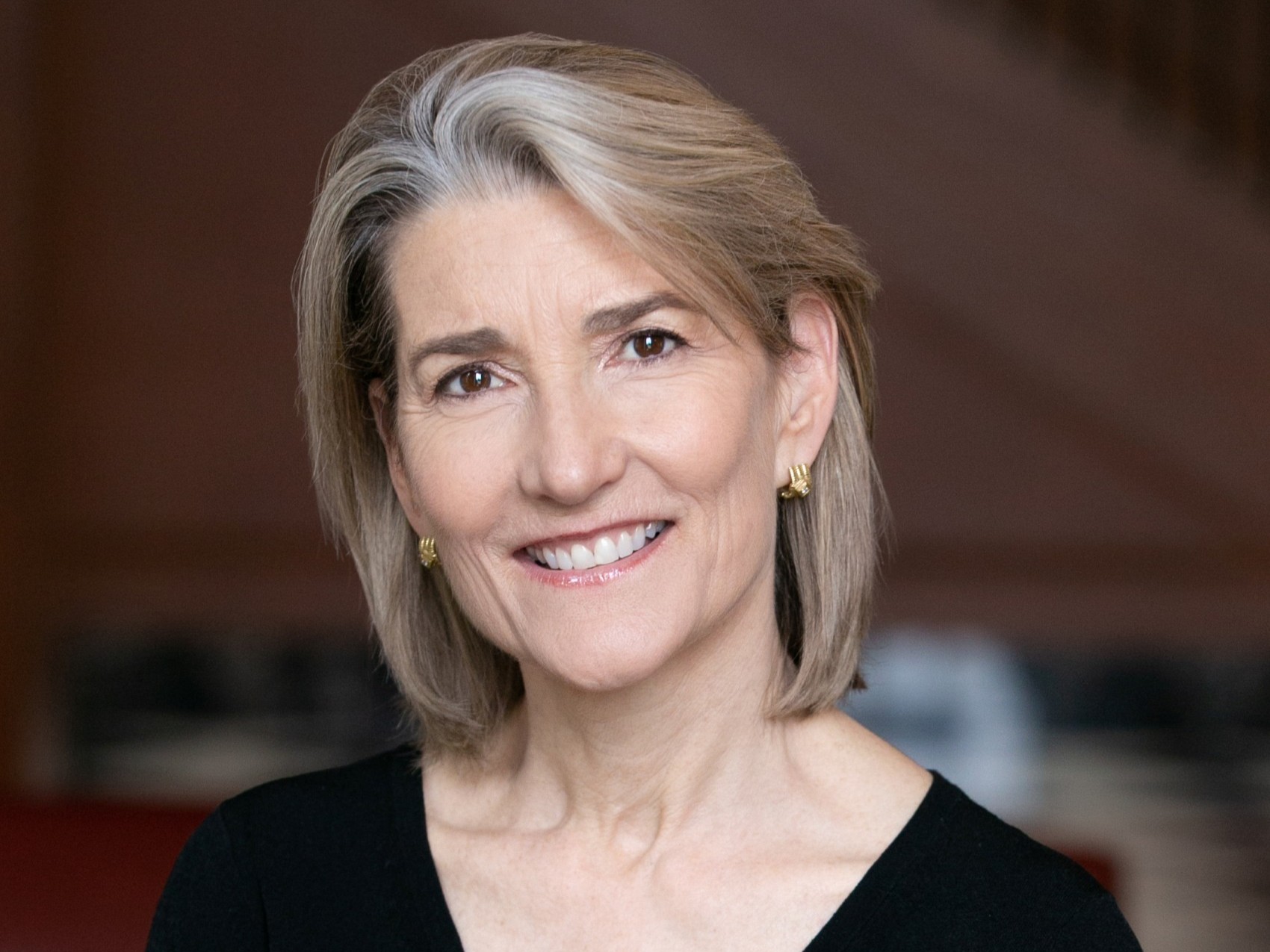
Foto: Evgenia Eliseeva / Wikimedia / Creative Commons
Promoting of doctors
Promoting of doctors
Award of doctoral degrees and congratulations to the new doctors by Pro-Rector for Outreach and Social Responsibility Monica Rolfsen
Dear new doctoral graduates!
Warmest gratulations!
As we gather to celebrate your monumental achievement of earning a doctorate, it is worth remembering that academic ceremonies like this date back centuries. In the beginning, they were privileges reserved mainly for priests and lawyers. And, of course, only men.
Fortunately, much has changed since then. Yet some things remain the same. This is still a ceremony honoring scholars at the highest level.
Today marks your new and well-earned status. Since defending your dissertation, you have been entitled to add three letters to your name: PhD.
These letters stand for science, knowledge, and truth.
They also testify to the perseverance required to earn them.
One thing is certain: a doctorate from NTNU is not easily earned.
Now that journey is behind you. The PhD is the reward.
A doctorate is a door-opener to professional life at the highest level. It gives you authority as an expert in your field. You have gained advanced knowledge and competence that gives you a unique ability to focus, to lead, and to solve problems that extend far beyond your dedicated specialization.
A PhD also comes with responsibilities to use your knowledge wisely, and the privilege to contribute to a better society.
- To take part in a professional world that need your skills
- To speak up and engage with society.
- To debate and ask questions that otherwise might not be asked.
- To propose solutions to problems that would have remained unsolved.
I urge you also to lend your voice and to speak for those who need it the most, and to stand up for issues beyond your research.
Your journey does not end here.
Keep exploring.
Collaborate with colleagues at home and abroad.
Build networks.
Curiosity fuels innovation and progress. So please stay curious!
Your friends and family have seen how hard you have worked. They have stood by you along the way, and many of them are here with you today.
On behalf of NTNU I thank you for your support.
In addition, my warm thanks go to the academic staff at NTNU who have contributed to co-operation and supervision. And not to forget our partners both in the private and public sector, as well as in academia both in Norway and internationally. Good partnerships are crucial in creating doctoral work of high quality.
Most of you have already left our university to start your career elsewhere. Some of you have also left Norway. Whatever your choice of profession, or wherever you go, I wish you all the best!
In a world where democracy and fundamental values are increasingly being challenged, knowledge and the role of universities are more important than ever. Recently, we have seen encouraging signs that give us reason to be optimistic about the younger generation and the future they will help shape. As you continue your journey through life, you can contribute to safeguarding our society and its democratic values.
Challenges cannot be solved through slogans, wishful thinking, or simple answers.
- They require knowledge.
- They require critical thinking.
- They require people who are willing to follow evidence wherever it leads.
- They require people like you.
Because the future will not be shaped by those who shout loudly.
It will be shaped by those who understand it the best.
So therefore, go forward with confidence, courage, and purpose.
And once again:
Congratulations, Doctors. The world needs you!
***
After the diploma ceremony:
You are all hereby promoted to doctors at the Norwegian University of Science and Technology, and are thereby granted jus docendi, or the right to lecture at NTNU.
I also declare the other doctors not present today to be promoted in absentia.
Music
Trondhjems Studentersangforening | Conductor: Sebastian Lyng Malmo
- «Sjungom» - composer: Prins Gustaf av Sverige og Norge, lyrics: Herman Sätherberg
Diploma artwork
Diploma artwork
Maja Horvath is born and raised in Hungary, Budapest. Graduated as a photographer in Hungary, and now doing her master degree at Trondheim Academy of Fine Art.
She has a background in graphic design and painting, by now developed interest in videoart. In her practice uses digital materials, playing with the unexpected, searching for hidden structures and poetical factors of coincidences.

