
Navigation

  • Skip to Content
NTNU Home NTNU Home

Department of Teacher Education

  • Studies
    • Master's programmes in English
    • For exchange students
    • PhD opportunities
    • All programmes of study
    • Courses
    • Financing
    • Language requirements
    • Application process
    • Academic calendar
    • FAQ
  • Research and innovation
    • NTNU research
    • Research excellence
    • Strategic research areas
    • Innovation resources
    • PhD opportunities
  • Life and housing
    • Student in Trondheim
    • Student in Gjøvik
    • Student in Ålesund
    • For researchers
    • Life and housing
  • About NTNU
    • Contact us
    • Faculties and departments
    • Libraries
    • International researcher support
    • Vacancies
    • About NTNU
    • Maps
  1. Department of Teacher Education Research
  2. How to do things with disability
  3. LOS8011 How to do research with disability

Språkvelger

Norsk

LOS8011 – How to do things with disability – Research – Department of Teacher Education

×
  • How to do things with disability
  • LOS8011 How to do research with disability
MENU

LOS8011 How to do research with disability

LOS8011 How to do research with disability

Disability-affirmative research, pedagogies, and practice

This PhD course seeks to introduce participants to key concepts and directions in disability-affirmative research and practices. Through its hybrid format, the course provides room for intellectual discussion and exploration as well as time for creative and practical design making and writing. The course has grown out of the NTNU-led international research group How to do things with disability (DOABLE).
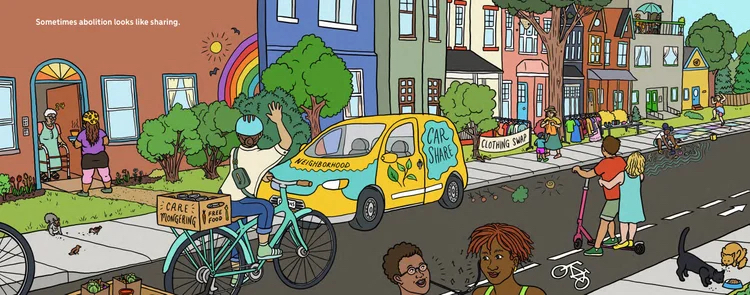
A colorful illustration of a lively neighborhood street. People are engaging in community activities such as riding bicycles, walking, and talking. A yellow van labeled 'Car Share' is parked near a sidewalk with a sign reading 'Neighborhood.' Another sign says 'Clothing Swap,' placed near a table with items. There are trees, multi-colored houses, and a rainbow mural on one building. A person on a bicycle carries a box labeled 'Care Mongering – Free Food.' Children are playing with scooters and a black cat is on the sidewalk. PNG
Spread from Abolition is Love (2023) by Syrus Marcus Ware and Alannah Fricker. Reproduced with permission from the artists. 

Course Dates 2026

May 6-7 (online) and August 11-12 (in person)

Credits: 5 ECTS

Application deadline: February 6, 2026.

Maximum participants: 16

Link to registration


Contact

  • Questions about course content: Tone Pernille Østern.
  • Enrollment and General Questions: forskning-phd@ilu.ntnu.no

Learning methods and activities

  • Hybrid course
  • English language
  • Seminar-based with four teaching days in 2026: May 6-7 at 12-18 CET (online) and August 11-12 at 9-16 CET (onsite in Trondheim in Norway)
  • Individual and peer study between the teaching days in May and August

Compulsory course assignments [approved/not approved]

  • Project proposal & ethics
  • Peer process supervision, with individual reports from the supervision delivered
  • Oral presentation of project report
  • Attendance: 80%

Assessment form (Exam) [pass/fail]

  • A final reflection piece that draws together the three phases described under "Structure" further down: 3-4 pages, including engagement with key selected theoretical sources. All compulsory course assignments must be approved in order to deliver the exam. Deadline: 15 September 2026.

Required previous knowledge

  • Master’s Degree or equivalent

Course materials

  • A self-chosen research context where the own mini research project can be carried out, with ethics approval
  • Compulsory reading list of 150 pages + self-chosen 2 articles

Lecturers

Four circular profile images of the lecturers arranged in a row, each showing individuals with different hairstyles and clothing styles. Photo​

Lecturers

Tone Pernille Østern

Tone Pernille Østern

Tone Pernille Østern. photoTone Pernille Østern has a Dr. of Arts in Dance focused on dance and disability from the Theatre Academy at the University of the Arts Helsinki (Finland). Her doctoral project (Østern, 2009) was practice-led and included the foundation and development of artistic working methods of the Dance Laboratory in Trondheim, Norway, a company with disabled and non-disabled dancers now housed by DansiT Choreographic Center. With three decades of leading disability-affirmative research and inclusive arts education, she is Professor in Arts Education with a focus on Dance at the Department for Teacher Education at NTNU (Norway). She is also Visiting Professor in Dance Education in Contemporary Contexts at Stockholm University of the Arts (Sweden). She has taught extensively on Master and PhD level. She is the leader of NTNU’s research group, How to do things with disability (DOABLE) and she has led several research projects such as the Arts and Culture Norway commissioned work resulting in Artist – an available profession? A research project about artists with disabilities in Norway (Østern et al., 2023), and edited and published widely, such as Glørstad, V., Østern, T.P., McCaffrey, T., Chikonzo, K., & Chivandikwa, N. (Eds.), Theatre and Performing Arts, Disability Citizenship and Community Development – Perspectives from the Global South and North.

Dr. Syrus Marcus Ware

Dr. Syrus Marcus Ware

Syrus Marcus Ware. PhotoDr. Syrus Marcus Ware is a Vanier Scholar, visual artist, activist, curator, and educator. Syrus is Assistant Professor at the School of the Arts, McMaster University (Canada). Using drawing, installation, theatre/ performance, Syrus works with social justice frameworks and Black activist culture. His work was part of the inaugural Toronto Biennial of Art (2019, 2022) in conjunction with the Image Centre (Antarctica and Ancestors, Can You Read Us? (Dispatches from the Future and MBL: Freedom). Syrus holds a doctorate from York University (Canada), and he is the co-editor of the best-selling Until We Are Free: Reflections on Black Lives Matter in Canada (2020), Marvellous Grounds: Queer of Colour Histories of Toronto (2018) and Queering Urban Justice: Queer of Colour Formations in Toronto (2018). Syrus has authored several children’s books including Abolition Is Love (2023). He is part of the Performance Disability Art Collective and co-programmed Crip Your World: An Intergalactic Queer/POC Sick and Disabled Extravaganza as part of Mayworks 2014. Syrus is also co-curator of The Cycle, a two-year disability arts performance initiative of the National Arts Centre (Ottawa). He is a co-founder of Black Lives Matter-Canada and the Wildseed Centre for Art & Activism.

Matthew Reason

Matthew Reason

Matthew Reason. PhotoMatthew Reason is Professor of Theatre and Director of the Institute for Social Justice at York St John University (UK). His research focuses on politically and socially engaged arts practice, audience research and co-productive and participatory research methodologies. He is interested in research as a creative and relational activity and the relationships between research, activism and epistemic justice. Central to his work is collaborative partnerships with arts organisations, with examples including Imaginate, Mind the Gap, Teatrecentrum and Theatre Hullabaloo. He has received research funding from the Arts and Humanities and Natural Environment research councils, including for I’m Me (2023-25) which explored themes of identity, representation and voice with learning disabled and autistic artists. He has published widely in journal and book form. Recent publications include the Routledge Companion to Audiences and the Performing Arts (co-edited with Conner, Johanson and Walmsley, 2022).

Libe García Zarranz

Libe García Zarranz

Libe García Zarranz. PhotoLibe García Zarranz is Professor of Cultural Theory and Literatures in English in the Department of Teacher Education at NTNU (Norway). She is also Research Affiliate for the Centre for Literatures in Canada at the University of Alberta (Canada). Her work sits at the intersection of feminist, queer, crip, and trans literatures, visual cultures, theories, and pedagogies. She is the author of TransCanadian Feminist Fictions: New Cross-Border Ethics (2017), the co-editor of the special issue Affect and Feminist Literary and Cultural Production (2018) for Atlantis: Critical Studies in Gender, Culture, and Social Justice, and the co-editor of the collection Living and Learning with Feminist Ethics, Literature, and Art (2024). She is the leader of NTNU’s research group TransLit: Sustainable Ethics, Affects, and Pedagogies and a member of the international research project Communitas/Immunitas: Relational Ontologies in Atlantic Anglophone Cultures of the 21st Century, funded by the Spanish Ministry of Science and Innovation. She has 16 years of university teaching experience, with more than 40 different courses taught at the undergraduate, graduate, and doctoral levels. One of the joys of her profession is to learn and unlearn with Master’s and PhD students. Born and raised in Spain, and educated in Canada and the UK, Libe currently teaches, researches, and contributes to public outreach in Trondheim.

About LOS8011

This PhD course will be housed in the Department of Teacher Education (ILU) at NTNU in Norway, across the Section for the Arts and the Section for English and Foreign Languages, together with international faculty based at York St John University in the UK and McMaster University in Canada. The seminars will be grounded on the intersection of educational and artistic practices, focusing on the pedagogical and aesthetic dimensions of disability-affirmative research.

About the PhD course

About the PhD course

This course asks:

  • What happens when the practice of researching about disability is challenged?
  • What does researching with disability afford instead?

Doing research with disability entails the practical (disability-led practice, consistent attention to questions of access), the epistemological (centering of lived experience, valuing of disability knowledge), the affective (engaging with the centrality of emotion to disabled and neurodivergent cultural and social life), and the ethical (practicing individual and institutional allyship).

The course will thus foreground disability-led research, guided by intersectional, co-productive, arts-based and creative methods that are threaded throughout research design, ethics, delivery, analysis, and dissemination. Ultimately, this course should provide participants across disciplinary backgrounds with critical awareness of common theoretical concepts used in disability-affirming research, and ways to apply these to their various disciplines.

Learning outcomes

Learning outcomes

Knowledge

The Candidate

  • has advanced knowledge of current thinking and practice in disability-affirmative research. 
  • has expert knowledge about selected current concepts of importance for disability-affirmative research including disability justice frameworks or other intersectional approaches.
  • has advanced knowledge about participatory methods and inclusive research suitable in the own research context.

Skills

The Candidate

  • has the ability to critically apply their knowledge about disability-affirmative research in analysis of their own research material and context. 
  • has the ability to creatively, ethically, and reflexively develop and conduct a small-scale disability-affirmative research project. 
  • has advanced skills in adopting and creating participatory methods and inclusive research that is helpful for disability-affirmative research in their own research context.

General Competence

The Candidate

  • has developed advanced skills in critical self-reflection on their research practice in a manner that contributes to new and critical theory/practice building. 
  • has advanced skills collaborating and supporting peer-participants with diverse and unique abilities.  
  • has increased their knowledge around the ethics of research, in particular around questions of positionality, accountability, intersectionality, and care.

Structure

Structure

This course is structured in three phases:  

Phase One (online)

Participants will be introduced to a series of disability-affirmative research concepts and methods through online seminars (May 6-7), combined with reading and working in smaller seminar groups with a course lecturer as supervisor. By June 1, the participants submit their compulsory coursework 1 “Project proposal & ethics.” The proposal describes what they will do in the next phase where they will creatively and critically carry out their mini research project.

Phase Two (done in the participants’ own contexts + peer and course teacher online sharing and supervision)

Following the development of a project proposal, participants will apply selected approaches to their own research context in the form of a mini-research project, self-designed with the help of a course lecturer as supervisor. During the mini-project, participants will meet online once for a supervision meeting. At the end of the mini-project, participants will prepare a presentation with a self-chosen format that could include an oral, multimodal, and/or arts-based presentation, experimenting with interactivity and/or engaging with the city/a site specific location.

Phase Three

Participants and lecturers will come together for an in person 2-day long colloquium at NTNU, Trondheim, on August 11-12, at which they will present their mini research conducted in Phase 2, share with, and learn from their cohort of peers.

An examination consisting of a reflection piece that draws together the three phases will follow. Examination deadline: 15 September 2026.

NTNU – Norwegian University of Science and Technology

  • For employees
  • |
  • For students
  • |
  • Intranet
  • |
  • Blackboard

Studies

  • Master's programmes in English
  • For exchange students
  • PhD opportunities
  • Courses
  • Career development
  • Continuing education
  • Application process

News

  • NTNU News
  • Vacancies

About NTNU

  • About the university
  • Libraries
  • NTNU's strategy
  • Research excellence
  • Strategic research areas
  • Organizational chart

Contact

  • Contact NTNU
  • Employees
  • Find experts
  • Press contacts
  • Researcher support
  • Maps

NTNU in three cities

  • NTNU in Gjøvik
  • NTNU in Trondheim
  • NTNU in Ålesund

About this website

  • Use of cookies
  • Accessibility statement
  • Privacy policy
  • Editorial responsibility
Facebook Instagram Linkedin Snapchat Tiktok Youtube
Sign In
NTNU logo