
FJORD-FORMING - Fjord Systems - NTNU Ocean and Coast
FJORD-FORMING
Rethinking, Mapping and Narrating the Long History of Human-Nature Entanglements across Land and Sea.
The Project Fjord-Forming is proposed to answer the call for new knowledge and solutions to support sustainable and resilient fjord systems.
The project starts in June 2026, with the announcement of one PhD position with application deadline 15 June 2026:
Jobbnorge: PhD candidate in the History of Science
The project aims to provide:
- A new conceptual framework for analysis of human-nature entanglements over time in fjord systems.
- New narratives about the fjord system as guidance for future research and fjord management.
- A proof-of-concept of a database connecting historical and present data on pressure points and liminal zones in fjord systems such as the Trondheimsfjorden region.
The shape and state of the fjord Trondheimsfjorden, as we know it today, are the outcome of millennia of human interaction with the landscape. Human use has changed the fjord, but the fjord has also changed the human societies around it since the last Ice Age.
To understand trends, predict developments, and propose solutions for the future, we will examine how the history of the fjord region can be conceptualized, researched, and narrated. As such, our project seeks to improve our fjord literacy.
Overall, the FJORD-FORMING project poses the following research questions:
- How can we understand, conceptualize, and narrate the deep history of socio-environmental entanglements as formative of the fjord region?
- What constitutes pressure points and the liminal zones of the fjord region in terms of human-nature interaction, and how to convey knowledge of them?
Our hypothesis is that human-nature co-formations are most expressed at so-called pressure points and in the liminal zones of the fjord system.
Pressure points entail sites or nature types marked by highly intense human-nature interaction, while liminal zones are in-between states of nature, the thresholds and border areas between biomes or between natural and cultural landscapes.
Together, pressure points and liminal zones are ideal settings for studying how fjord-forming occurs, and our results will thus be transferable to other fjord systems.
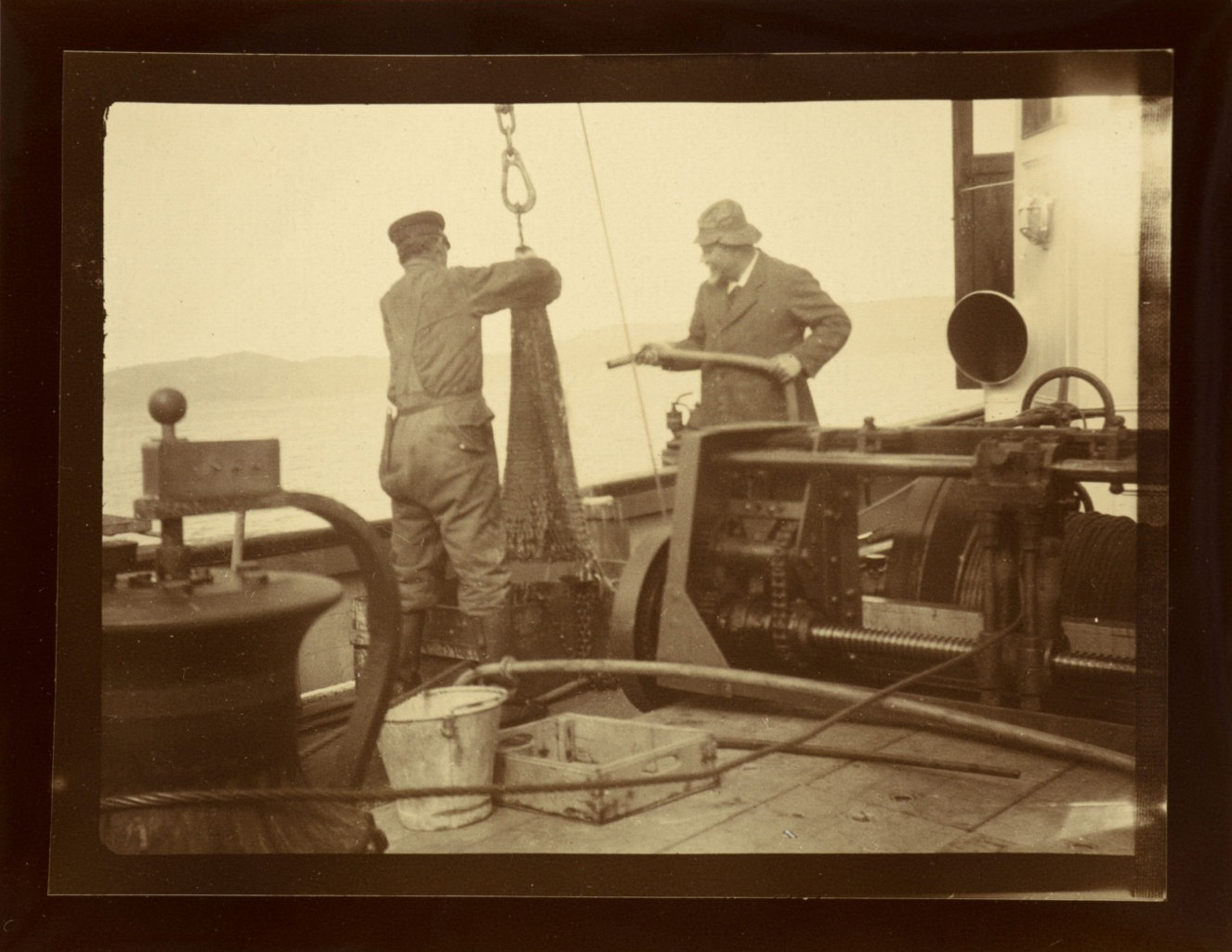
Photo: Cleaning of trawl on board the research vessel M/K Gunnerus, 1922. Photo: Carl Dons / NTNU Universitetsbiblioteket, A-0030-Dons-4357_01
Click on the image for a larger version
Participants
-
Torkild Bakken Associate professor
+4791111179 torkild.bakken@ntnu.no Department of Natural History -
Francisco J. Beltrán Tapia Professor in Economic History
francisco.beltran.tapia@ntnu.no Department of Historical Sciences -
Terje Finstad Professor
+47-73598357 +4795904814 terje.finstad@ntnu.no Department of Interdisciplinary Studies of Culture -
Mats Asklund Ingulstad Professor, Excellent Teaching Practitioner
+47-73598361 +4792268949 mats.ingulstad@ntnu.no Department of Historical Sciences