
COD-SPAWN - Fjord Systems - NTNU Ocean and Coast
COD-SPAWN
COD-SPAWN – Autonomous AI-Driven Monitoring of Cod Spawning and Pollution Dynamics in Borgundfjorden. What Happens When Cod Eggs Meet Pollution?
One of the flagship interdisciplinary projects within NTNU Hav og Kyst is COD-SPAWN.
The project starts in 2026 and brings together an interdisciplinary team including 2 PhD positions.
Every winter, one of Norway's most important natural events takes place beneath the surface of Borgundfjorden.
Millions of cod eggs are released into the fjord and begin a journey controlled by currents, tides, wind, freshwater inflows, and the complex dynamics of the marine environment. Some will survive and contribute to future fish populations. Others will not.
At the same time, microplastics, contaminated sediment particles, stormwater runoff, and pollutants from decades of human activity move through the same waters.
But what happens when these worlds collide?
Do pollution particles follow the same pathways as cod eggs? Are spawning grounds exposed to contamination during critical periods? How do changing environmental conditions influence the transport, distribution, and survival of eggs and larvae? And can we observe these processes as they happen rather than weeks or months later?
Today, we do not know.
Despite Borgundfjorden being Norway's second most important spawning area for coastal cod and a nationally prioritized site for sediment remediation, no technology exists that can continuously monitor cod spawning activity and pollution dynamics simultaneously in real time. Traditional monitoring relies on manual sampling and laboratory analyses, providing only isolated snapshots of a constantly changing ecosystem.
COD-SPAWN is changing that.
The project will develop and pilot a new generation of autonomous monitoring technologies capable of observing both cod spawning and environmental contamination directly in the fjord. By combining artificial intelligence, autonomous surface vessels, advanced imaging systems, environmental sensors, and real-time data analytics, COD-SPAWN will create an intelligent monitoring platform capable of detecting cod eggs, microplastics, suspended contaminants, and pollution events as they occur.
The project transforms Borgundfjorden and Aspevågen into a full-scale living laboratory where engineers, marine biologists, environmental scientists, and AI researchers work together to reveal processes that have previously remained hidden beneath the surface.
Work packages
The project comprises five closely integrated work packages:
WP1 – Smart Particle Sensors
Developing intelligent imaging technologies capable of distinguishing cod eggs from microplastics and other particles in real time.
WP2 – Autonomous Monitoring Platforms
Deploying sensors on autonomous vessels to provide continuous observations across the fjord.
WP3 – Artificial Intelligence and Data Analytics
Creating AI systems that automatically identify, classify, and interpret biological and environmental observations.
WP4 – Field Demonstration and Validation
Testing and validating the complete monitoring system under real spawning conditions in Borgundfjorden.
WP5 – Decision Support and Environmental Management
Transforming real-time observations into knowledge and tools that support fisheries management, environmental monitoring, remediation activities, and sustainable coastal governance.
By combining biology, environmental science, robotics, autonomous systems, and artificial intelligence, COD-SPAWN will create a living laboratory for next-generation fjord monitoring. The project will generate new knowledge on how pollution and environmental variability influence cod spawning while providing innovative tools for protecting marine ecosystems and supporting sustainable management of Norway's fjords and coastal waters.
COD-SPAWN is about seeing the invisible interactions between cod eggs, pollution, and the fjord environment—and turning that knowledge into smarter decisions for healthier fjords.
Click to view a larger version of the illustration showing the five work packages:
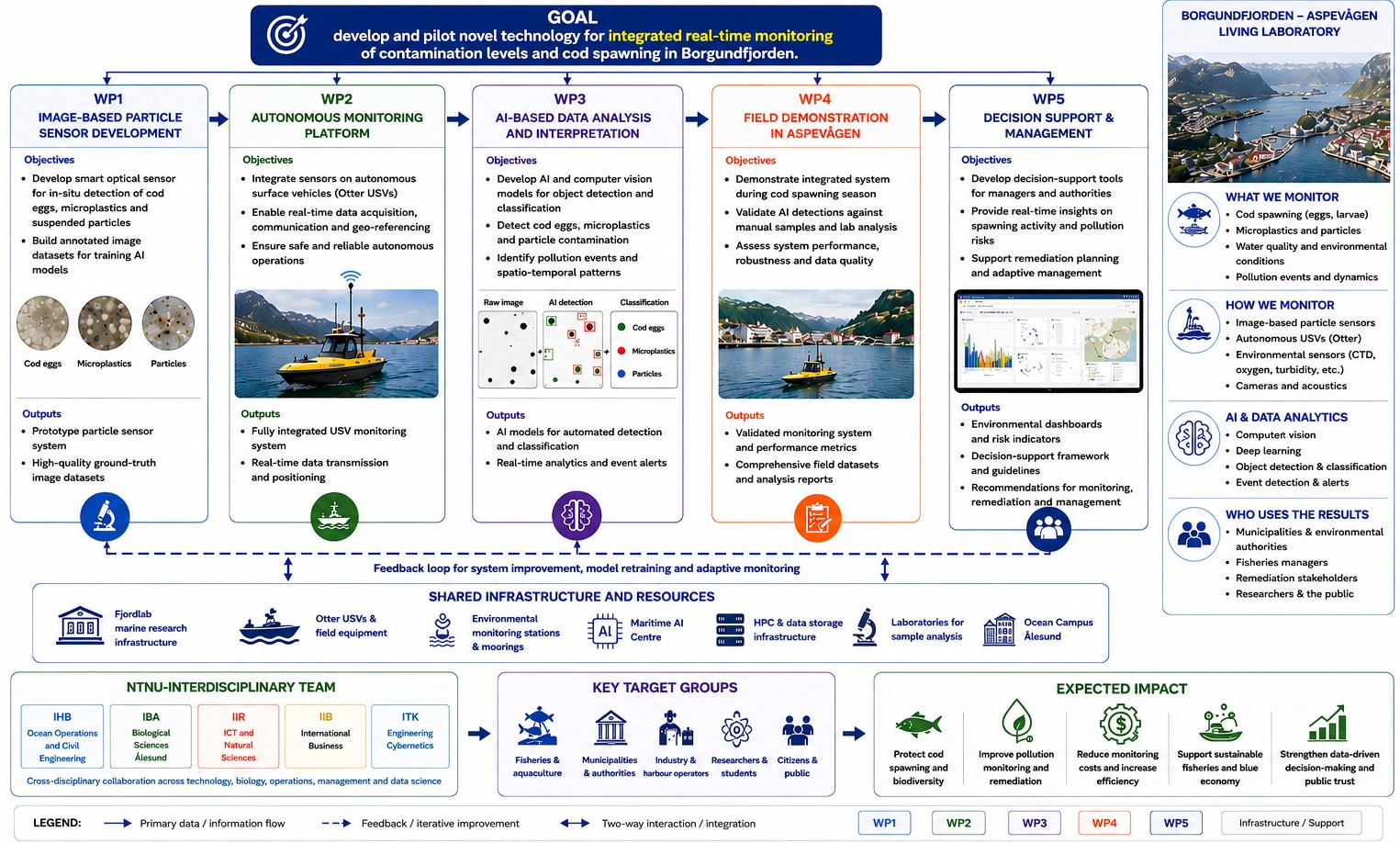

Photo: Research vessel on Borgundfjorden
Participants
-
Snorre Bakke Associate Professor
+4792687892 snorre.bakke@ntnu.no Department of Biological Sciences Ålesund -
Øystein Bjelland Associate Professor
+4792213506 oystein.bjelland@ntnu.no Department of Ocean Operations and Civil Engineering -
Robin T. Bye Professor and Deputy Head of Research
+47-70161549 robin.t.bye@ntnu.no Department of ICT and Natural Sciences -
Erlend Magnus Lervik Coates Associate Professor
+47-73559467 erlend.coates@ntnu.no Department of ICT and Natural Sciences -
Christina Carrozzo Hellevik PhD Candidate
+47-70161653 +4745545154 christina.hellevik@ntnu.no NTNU School of International Business -
Torodd Skjerve Nord Associate Professor. Deputy leader for Research.
+47-73595207 torodd.nord@ntnu.no Department of Ocean Operations and Civil Engineering -
Damiano Varagnolo Professor
+4748128922 damiano.varagnolo@ntnu.no Department of Engineering Cybernetics -
Marleen Wierenga Associate Professor
marleen.wierenga@ntnu.no NTNU School of International Business -
Houxiang Zhang Professor
+47-70161611 hozh@ntnu.no Department of Ocean Operations and Civil Engineering